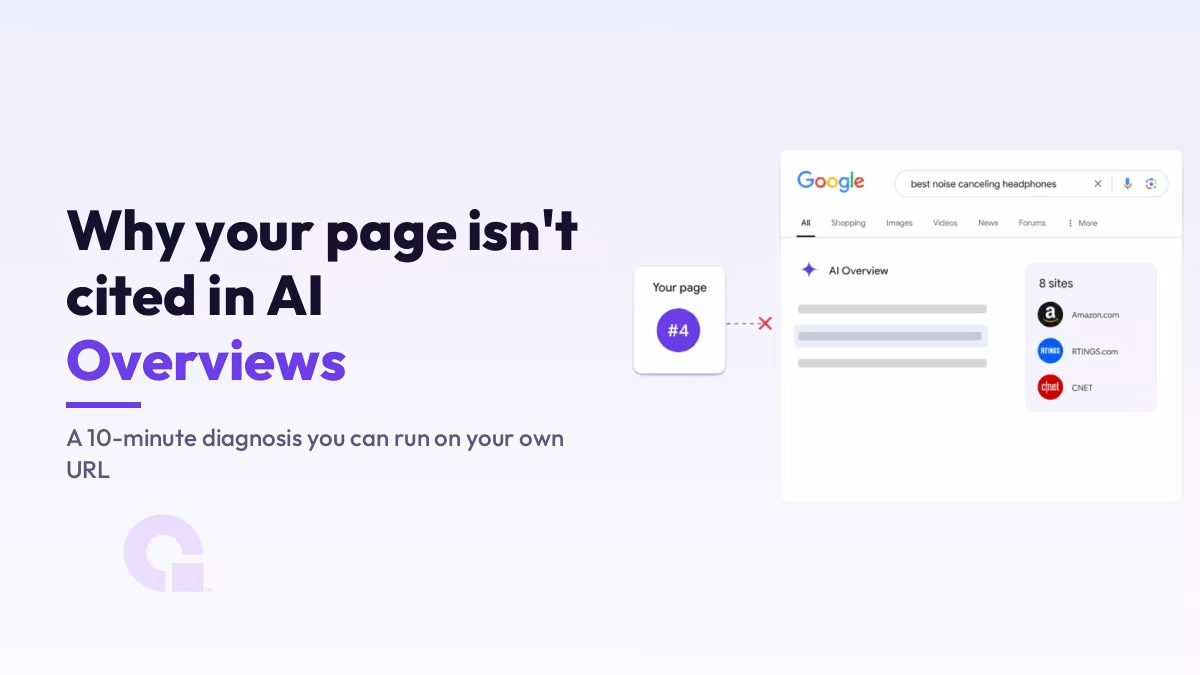
Your page sits on page one, an AI Overview fires on the query, and your URL is nowhere in the source panel. That is not a ranking problem, so ranking harder will not fix it.
Below is the 10-minute diagnosis I run, in an order that puts the cheapest checks first, and an honest split between the half you can fix this afternoon and the half that takes months.
Key Takeaways
- Ranking and being cited are two different jobs. Google’s own AI Overview, answering this exact question, says AI engines do not simply cite top-ranking pages.
- Before you change anything, look twice. The citation pool moves on its own: same query, same market, four hours apart, we counted 11 cited sites and then 9.
- A citation is not a position you take and hold. On our own page it was there in all four markets for four nights and then gone, with nothing on the page changed and its ranking flat.
- Google documents one hard eligibility gate: the page must be indexed and eligible to be shown with a snippet. A
nosnippet,data-nosnippet, or tightmax-snippettag quietly disqualifies a page that ranks perfectly well. - Extractability is the fixable half. Answer the question in the first 2 to 3 lines under the heading that asks it, then expand.
- Corroboration is the slow half. If no other trusted source says what you say, you are a risky thing to quote.
- Search Console cannot prove your position on a specific query at low impressions. We got that wrong on our own page and corrected it.
Ranking and being cited in AI Overviews are two separate jobs
A page can rank in the top 10 and still never be cited in an AI Overview, because ranking decides which pages Google shows and citation decides which passage the AI Overview lifts. Those are different selections, made on different criteria: the AI needs a concise, self-contained answer it can extract, from a source it feels safe attributing.
You do not have to take my word for it. I captured the US SERP for this exact question on 13 July 2026, and Google’s own AI Overview said it out loud.
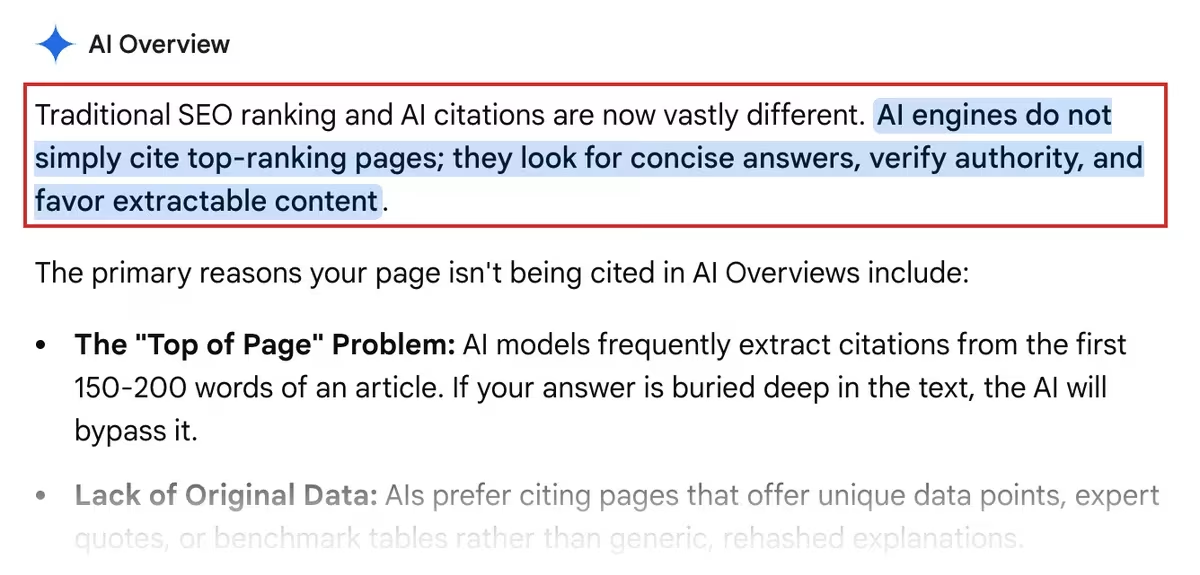
The highlighted line reads: “AI engines do not simply cite top-ranking pages; they look for concise answers, verify authority, and favor extractable content.”
So the feature we are all trying to get into is telling us, in its own answer, that our rankings are not the ticket. Honestly, that is a better piece of evidence than any of the correlation studies currently ranking for this query, and it costs nothing to check.
The 10-minute diagnosis for a page that is not cited
Almost every guide on this topic starts you on content surgery: rewrite the intro, add schema, add original data. Those things matter, and I will get to them, but they are steps three and four, not step one. Two cheaper checks come first, and they are the ones nobody runs.
The order I run the checks in
- Did an AI Overview even fire, and did you look twice?
- Is the page eligible to be cited at all (the snippet gate)?
- Can your answer actually be lifted off the page?
- Does anyone else back up what you are saying?
Step 1: check whether an AI Overview fires at all, then check it again
Before you conclude you were dropped, capture the query twice on different days and count the cited sources both times. AI Overviews do not fire on every query, and the set of sites they cite is not stable, so a single look can easily tell you a story that is not true. If you want a sense of how often the feature fires at all, I pulled that apart in how often AI Overviews actually appear, including why the published figures disagree with each other so badly.
Google says this itself in its AI features documentation: AI Overviews “are only shown when our systems determine that it is additive to classic Search, and as such, often don’t trigger.” Google is an interested party, but on this one its description matches what we see.
Here is our own number, and I will state the sample size out loud because it is small. On one query, in one market, on one day, we captured the AI Overview at about 01:50 and again at about 04:52. The first capture cited 11 sites. The second cited 9. Nothing on our page changed in those four hours.
That is an observation, not a law, and two captures of one query prove nothing about the internet. It is still enough to justify the rule: recapture before you conclude anything.
While you are in there, read the source panel properly. On the capture above, the AI Overview cited 8 sites, and the first one was not a polished SEO guide.
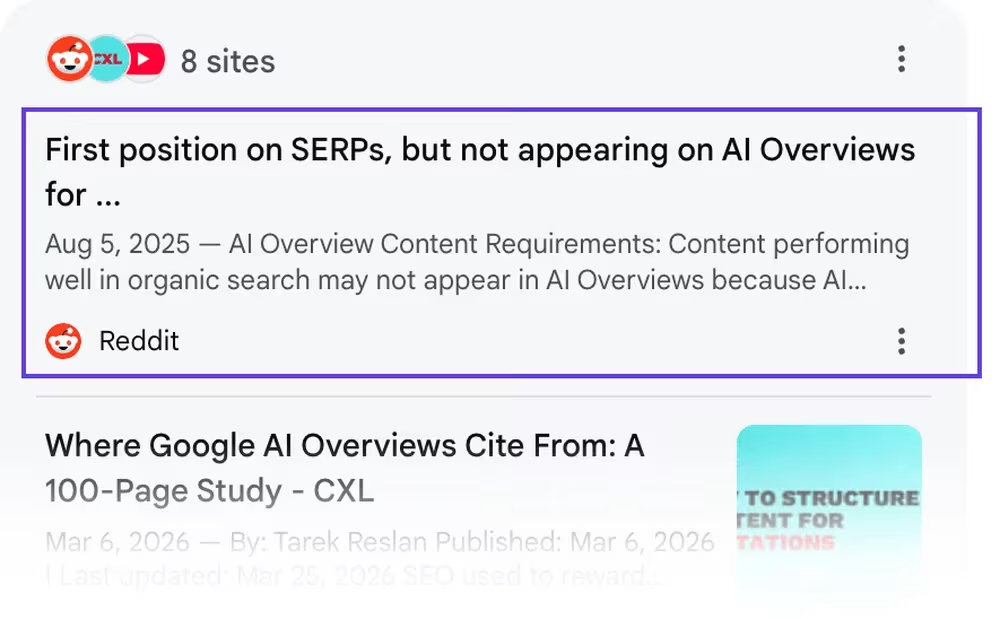
A Reddit thread from someone with exactly your problem got cited above a formal study. In every AI Overview we have captured so far, across six different queries, at least one Reddit thread appeared in the source set. Small sample, so I am calling it a pattern we keep seeing, not a percentage and not a rule about what Google prefers.
Can a citation just go away on its own?
Yes, and we watched it happen on our own page. The citation turned up in all four markets we track, held for four consecutive nights, and was gone by the fifth, with nothing changed on the page and nothing changed in its ranking.
Here is the shape with its dates. On our llms.txt experiment page we were not cited for nine straight rounds from 15 to 24 July 2026, then cited in all four markets for four straight rounds from 25 to 28 July, then not cited again on 29 and 30 July.
Two facts are what make that readable. Google refetched the page once on 13 July and then never came back, so every capture afterwards was reading a version that never changed underneath us. And the page’s Search Console position sat flat in the low 20s across both the entry and the lapse. The page did not move; the citation did.
A second experiment gives an even cleaner version of the same thing. A control page we deliberately never edited at all is screenshot-confirmed in the AI Overview sources panel in the United States and Canada on 25 July 2026, and not confirmed there on the nights either side. It walked in and back out while we sat on our hands.
So a citation is not a position you take and hold. On our data it behaved like a slot that gets re-decided on every fetch, which means extractability appears to buy eligibility rather than tenure.
The limits are part of the result, so here they are. This is one page, one query, four markets and one operator, plus a single eye-confirmed night on the control, all on a live property with Google changing underneath us. It supports “this is a lever and the citation may not stay”, never a percentage, and for any night nobody opened the screenshot the honest phrase is “not confirmed” rather than “not cited”, because a capture shows the visible part of the sources panel and not its full list.
That is why this sits inside the diagnosis rather than in a study writeup. If you run the four checks on a night your citation happens to be absent, you can diagnose a problem that is not there. So Step 1’s rule gets one notch stronger: it is not “look twice in one day”, it is look across several days before you conclude your page is the reason.
Step 2: check whether your page is eligible to be cited at all
A page can only be cited in an AI Overview if it is indexed and eligible to be shown in Google Search with a snippet. That means a nosnippet tag, a data-nosnippet attribute around the relevant text, or a restrictive max-snippet value will keep a perfectly good ranking page out of the citation pool, silently.
This is not my theory. Google’s AI features documentation states it plainly: “To be eligible to be shown as a supporting link in AI Overviews or AI Mode, a page must be indexed and eligible to be shown in Google Search with a snippet, fulfilling the Search technical requirements. There are no additional technical requirements.”
The same doc now carries a section called “Troubleshooting preview controls”, whose whole premise is that these tags do remove your content from AI features, and the only question is whether yours is implemented correctly and has been recrawled yet.
So here is the 30-second check. Open your page’s source and look at the robots meta tag in the <head>. You want to see nothing like this:
<!-- These keep you out of the citation pool -->
<meta name="robots" content="nosnippet">
<meta name="robots" content="max-snippet:0">

<!-- And this hides the specific passage you wanted lifted -->
<div data-nosnippet>Your best answer, invisible to AI Overviews</div>
What you want instead is a robots line that puts no ceiling on the preview. Here is the real one from the page I am running an experiment on later in this article, and max-snippet:-1 is the part that matters, because it means no length limit.
<meta name="robots" content="follow, index, max-snippet:-1, max-video-preview:-1, max-image-preview:large">Check the crawled HTML too, not just the source you see in your browser. Google’s URL Inspection tool shows you the HTML Googlebot actually received, and that is the version that counts, because a plugin or a CDN can inject a directive your browser view never shows you.
Now the honest part, since I do not want to launder a Google claim into a fact. We have not tested this ourselves yet. Google states the eligibility requirement and describes the causal link, which is the best evidence available and also evidence from an interested party. It is a 30-second check with a real fix behind it, so run it, but hold the mechanism as Google’s stated claim until someone (us, hopefully) tests it in public.
Step 3: check whether your answer can be lifted off the page
An AI Overview lifts a passage, not a page, so the answer to each question your page addresses has to sit in one self-contained chunk that still makes sense with the surrounding paragraphs removed. If the answer only emerges as a conclusion the reader assembles over a whole section, there is nothing to quote and you are out of the running even when yours is the best page on the topic.
In practice that means: answer the question within 2 to 3 lines, directly under the heading that asks it, then expand underneath. Same for your opening summary and your takeaways list, which are usually the two most quotable things you own.
Structure carries it the rest of the way. Headings that name their own subject, tables where the answer is genuinely a comparison, steps where the answer is genuinely a sequence, an FAQ block where readers genuinely ask follow-up questions, and proper coverage of the semantic, related, and long-tail question-based keywords around your topic, all inside one strong page rather than spread thin across five weak ones.
Freshness belongs in this bucket too, and it is cheaper than people think. A page whose facts, dates, and examples are visibly current is easier to quote than one that reads like 2023, and updating a strong page usually beats writing a weak new one.
CXL’s study of 100 AI Overview citations found that 55% of them came from the top 30% of a page, which is worth knowing and worth naming honestly: it is a measurement of where citations landed, not proof that moving your text upward causes a citation. Treat it as a hint about where the machine looks first, not as a law.
We tested the extractability half on ourselves, and that run closed on 29 July 2026. We restructured the section openers on our llms.txt experiment page so each answer sits in a liftable chunk, and the page did enter the cited set in all four markets for four nights running before dropping back out again.
The section above on whether a citation can go away on its own carries the dates and the limits. The short version: on our data this looks like a lever for eligibility, not a way to keep a slot, and we are publishing that either way because we said we would.
Step 4: check whether anyone else backs up what you are saying
An AI Overview is safer quoting a claim that other trusted sources also make, so a page that answers a settled question in an unusual way is a risky citation even when it is right. Corroboration is the slow half of this problem, and it is the half nobody sells you, because you cannot ship it in an afternoon.
This does not mean you have to become an echo. It means the factual answer inside your quotable passage should agree with what the good sources agree on, while your judgment, your data, and your counter-read live in the body and the conclusion where they belong.
If you are answering a question nobody else has bothered to answer, you have no corroboration problem at all, because there is no consensus to sit outside of. Those unanswered sub-questions are the cheapest citation slots on the internet and most sites walk straight past them.
The levers that genuinely feed this side are slow ones: being cited by others, having a real named author with a track record, and adding evidence nobody else has. Our own tests on whether statistics improve AI citations and on schema markup and AI citations cover two of the levers people most often expect to be shortcuts.
What each check actually proves
| Check | Time | What a failure here proves |
|---|---|---|
| Recapture the AI Overview | 2 minutes | You were never dropped; the pool simply moved, or the feature did not fire. |
| Recheck across several days | A week | The slot is being re-decided, not lost. A citation can lapse on a page you never touched. |
| Robots meta and crawled HTML | 30 seconds | You are not eligible to be cited, no matter how good the page is. |
| Answer-first passages | An afternoon | Your answer exists but cannot be lifted out, so there is nothing to quote. |
| Corroboration | Months | You are quotable but risky to attribute, so a safer source wins the slot. |
What Search Console can and cannot prove about your position
Search Console reports an average position for the page across all the queries it appears for, so at low impressions it cannot tell you what position you hold on one specific query. Below Google’s anonymization threshold, the query rows simply are not returned, and the page-level average, its impressions, and its click-through rate are all you get.
I know that because I misread our own data first. Here is the actual report for our llms.txt page, filtered to that one URL, over the 28 days to 12 July 2026.
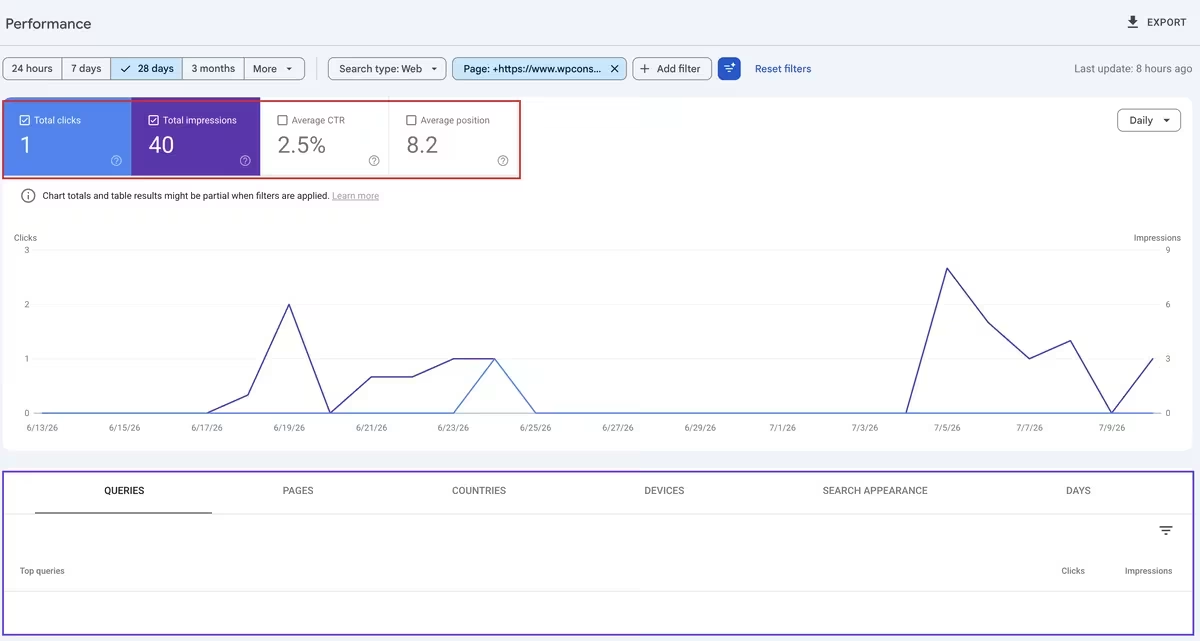
Look at the two boxes together, because the story is in the gap between them. The metrics are right there, so it is tempting to read “position 8.2” as our rank for the query. The Queries tab underneath is empty, which means Search Console will not tell us a single query that page appeared for.
We told ourselves “we rank 8.2 for this query and Google cited someone else instead”. It was a better story than the data supported. What the data supports is that the page averages 8.2 across whatever queries it shows up for, which is not the same claim at all.
So we corrected it in our study file and I am telling you here, because a small site’s Search Console will lie to you in exactly this way, and a diagnosis is worth very little if it does not name the tests that mislead you.
If you want to measure what AI Overviews are costing you rather than argue about position, that is a separate job with its own method, and I walk through it in measuring AI Overview traffic loss.
The numbers in AI Overview advice that you should not repeat
Two figures circulate constantly in this conversation and neither one survives a check, so do not build a strategy on them.
- “AI models extract citations from the first 150 to 200 words.” That precise-sounding number came out of the AI Overview itself in our capture, with no source visible in the panel. An AI answer asserting an unsourced statistic about how AI answers work is a nice illustration of the whole problem, and I would not put it in a deck.
- “96% of cited pages pass an E-E-A-T filter.” I could not trace this to any primary study. It gets quoted anyway, which is how a number becomes furniture.
The wider issue with the pages ranking for this query is not that they are dishonest, it is that their numbers are correlational and none of them can be checked by you, on your page, this afternoon. The checks above can.
This is a hill I have died on before. I wrote up the test I run instead of trusting what Google and OpenAI say about AI citations, and the short version is the same as the long version: log what the machine actually cites, on your own queries, and believe that over anybody’s press release.
So why isn’t your page cited in AI Overviews?
In my experience, most of the time it is one of three things, in this order of likelihood: nothing is wrong and you looked once at a pool that moves, or you are quietly ineligible because of a snippet directive nobody remembers adding, or your answer is genuinely on the page but buried where nothing can lift it.
The advice to add schema, chase E-E-A-T, and publish original data is not wrong, and I do all three. It is just expensive, slow, and unverifiable, and it is a strange place to start when two free checks sit in front of it.
What I would push back on hardest is the idea that this is always a content-quality problem. Often it is a plumbing problem wearing a content-quality costume, and the fastest way to find out is to run the cheap checks before you rewrite a single paragraph. The second-fastest is to look again next week, because our own citation came and went while the page sat still.
Ran the checks and still stuck?
Send me the URL and the query and I will take a look. You can contact us or email me directly. If it turns out to be an eligibility tag, it is a two-minute fix and you should not be paying anyone to find it.
Update Logs
31 Jul 2026
- Added a section on whether a citation can disappear on its own, built on our own dated result: our page was cited in all four markets for four consecutive nights and then was not, with nothing on the page changed and its position flat, plus a control page we never edited that entered the sources panel and left again.
- Corrected the extractability paragraph in Step 3, which still described that test as running after it had closed on 29 July, and replaced it with the outcome we promised to publish either way.
13 Jul 2026
- Added the real Search Console report behind the position claim, showing 40 impressions at an average position of 8.2 and an entirely empty Queries tab, plus the robots meta line from the page we are testing.
- First published, built on our own AI Overview captures from 12 and 13 July 2026 and Google’s AI features documentation, including our correction of an earlier overclaim about what Search Console position data can prove.
Want our posts to show up more often on Google?
One step & Google will surface this site in your Top Stories.