

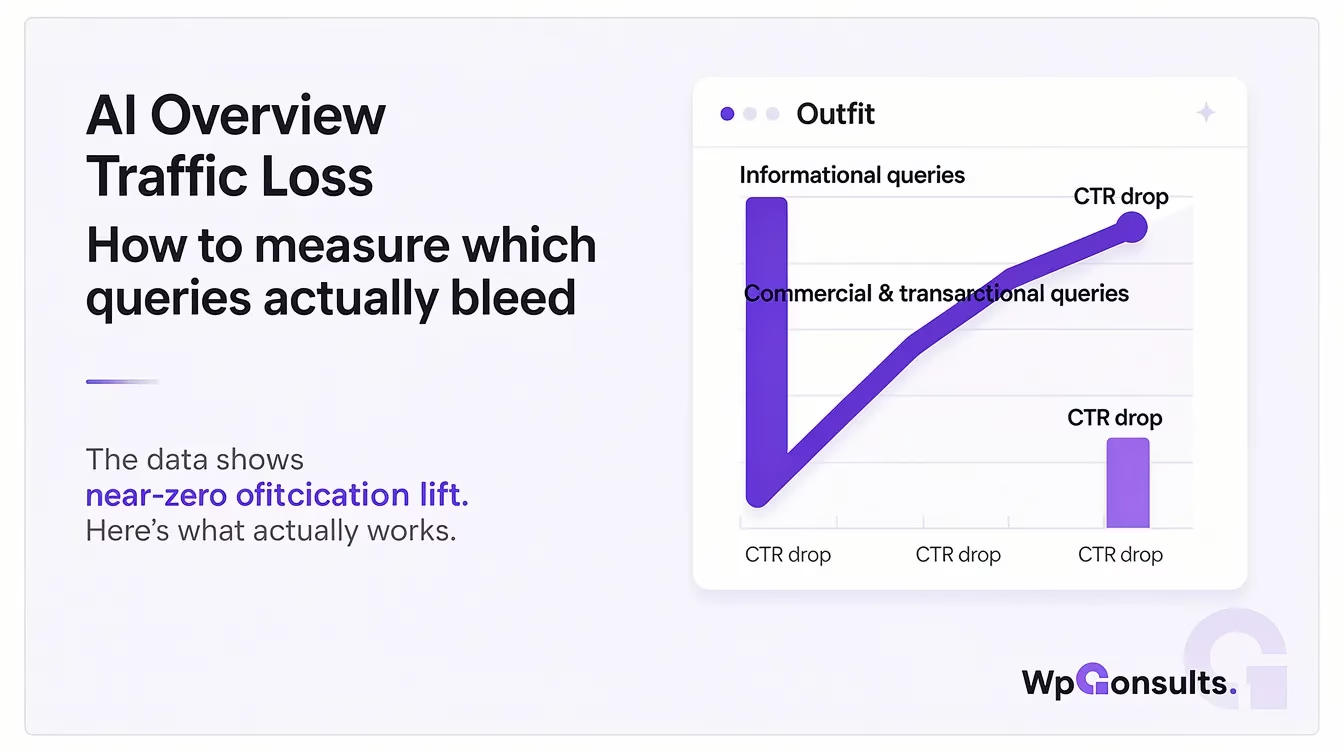
Two narratives about AI Overviews are circulating at once: one says they are draining search traffic, the other says getting cited wins you more clicks. Both are right, just for different queries, so arguing about the blended average gets you nowhere.
In this piece I will show you why the two stories can both be true, and give you a step-by-step way to measure exactly which of your own queries are losing traffic to AI Overviews inside Google Search Console.
Key Takeaways
- AI Overviews hit informational queries hardest, where the answer fits in the box; commercial and transactional queries hold up far better because the user still has to leave Google to act.
- The “AIO killed my traffic” and “AIO sends me more clicks” camps are both reporting real data, just from different segments of the SERP.
- Blended, site-wide CTR hides the only thing that matters operationally: which segments are bleeding and which are stable.
- A CTR drop is often impressions rising while clicks stay flat, not a ranking loss, so check position before you panic.
- The fix is segmentation in Google Search Console: tag AIO presence, split by intent, then read clicks against impressions.
- Search Console now has a native Search generative AI performance report (impressions only) plus an opt-out toggle; access has expanded past the UK to the US, India, and more, but it is still rolling out, so until it reaches your property external tagging stays the method.
- Put budget where money still clicks (commercial and cited pages) and stop over-investing in thin informational pages an AIO answers in two sentences.
The short answer: both narratives are true, just not for the same query
If you want one rule to take away: AI Overviews crush click-through rate on informational queries where the answer fits in a paragraph, and barely dent (sometimes help) commercial and transactional queries where the user still has to leave Google to act.
The “AIO destroys traffic” camp is measuring the first kind. The “get cited and you win more clicks” camp is measuring the second. Neither camp is lying; both are just over-generalizing from their own slice of the SERP. Your job is to stop arguing about the average and measure your own queries, one segment at a time, inside Google Search Console.
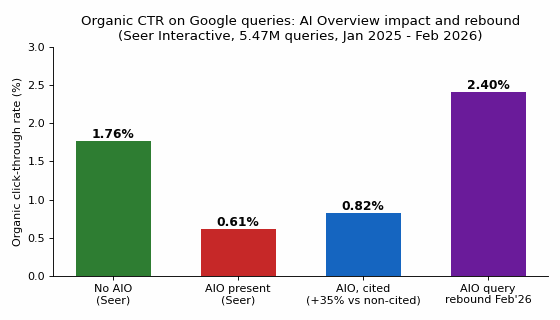
The numbers people throw around are real, but they describe populations, not your site. Ahrefs, analyzing 300,000 keywords, found the top organic result takes a 58% lower CTR when an AI Overview is present. Seer Interactive, across 5.47 million tracked queries, measured organic CTR on AIO queries falling from 1.76% to 0.61%, a 61% drop, while non-AIO queries actually rose.
AI Overviews now appear on roughly 48% of queries as of March 2026, up from 34.5% in December 2025. And the zero-click rate sits near 65% overall, climbing to about 83% when an AIO is on the page, per SparkToro and Datos clickstream data. All true, and all useless for deciding what to do with a specific URL until you segment.
Why the two narratives can both be right
A search engine result page is not one market, it is many. The mistake in nearly every “AIO is killing SEO” post and every “just get cited” rebuttal is treating the SERP as homogeneous and reporting a blended average. Blended averages hide the only thing that matters operationally: distribution.
Three mechanics drive the split. First, answer completeness. When the AIO fully satisfies intent (“how many ounces in a cup”, “what is a 301 redirect”), there is no reason to click anything, so the informational page underneath loses its clicks.
When the AIO can only orient the reader (“best CRM for a 12-person agency”), the user still clicks through to compare, sign up, or buy.
Second, citation position. Seer found brands cited inside the AIO earn about 35% more organic clicks than non-cited brands on the same query, while uncited competitors absorb the full decline. Being in the box is a different game from sitting in the blue links below it.
Third, recovery is uneven. CTR on AIO queries rebounded from 1.3% in December 2025 to 2.4% in February 2026, an 85% jump in two months, as Search Engine Land’s recovery study reported. But that floor lifting back up is concentrated where users have a downstream action to take, not on the encyclopedia-style queries that were hit hardest first.
So “AIO destroyed my traffic” and “AIO sends me more clicks” are not really contradictory claims. They are accurate reports from two different neighborhoods of the same SERP, which is why the honest move is to stop leaning on the average and measure your own queries instead.
How to measure AI Overview traffic loss in Google Search Console
Google does not hand you an “AIO present: yes/no” column yet; the native Search generative AI report covered in the next section is starting to change that, but it is impressions only and still rolling out property by property. Until it reaches yours, you build the segmentation yourself. Here is the method, in the order that actually works.
Step 1: Establish a clean before/after window
Pull GSC Performance data by query for two comparable periods. Do not compare last month to this month if a core update or seasonality sits between them. The defensible comparison is year-over-year on the same calendar weeks, which controls for both seasonality and the staggered AIO rollout. Export clicks, impressions, and position per query for both windows.
Step 2: Flag which of your queries trigger an AIO
This is the step everyone skips, then wonders why their analysis is noise. GSC will not tell you AIO presence on most properties yet, so you tag it externally. For a small set, check manually in an incognito window. For anything at scale, pull AIO presence per keyword from a rank tracker that records SERP features (Semrush, Ahrefs, and SE Ranking all expose an “AI Overview” feature flag). Join that flag back to your GSC export on the query string, and you now have every query labeled AIO or non-AIO.
Step 3: Segment by intent, not just by AIO presence
AIO presence alone will mislead you, because intent is the real driver. Split your AIO queries into informational (how, what, why, definitions, comparisons-for-learning) and commercial or transactional (buy, price, near me, best X for Y, brand plus product). The fastest honest proxy is to bucket by the landing page type: blog and glossary URLs skew informational, while product, category, pricing, and service pages skew transactional. Now you have a 2×2: AIO or non-AIO crossed with informational or commercial.
Step 4: Compute true citation lift versus cannibalization
For the AIO-present queries, you need to know whether the AIO is feeding you or eating you, and the signal is the relationship between impressions and clicks. If impressions held or grew while clicks fell, that is cannibalization: Google is showing you (often inside or beside the AIO) but users are not clicking because the answer is already on screen. If clicks held or grew on a query where you are cited in the AIO, that is genuine citation lift.
The trap is reading a CTR drop as a ranking loss, because as the Seer data shows, much of the “collapse” is a math artifact: impressions doubled while clicks stayed flat, so CTR fell without a single position lost. So check position before you panic; if position is stable and CTR fell, the AIO is the cause, not a demotion. This is the same “fake ranking drop” misread I have dismantled before in the context of Google’s ranking-volatility signals.
Search Console now shows native AI Overview data (the Search generative AI report)
Everything above assumes GSC stays silent about AI surfaces, and that assumption has expired. On June 3, 2026, Google launched a dedicated Search generative AI performance report in Search Console, showing how your pages appear across AI Overviews, AI Mode, and generative features in Discover: impressions from those surfaces, which pages show up, and in which countries.
How to read the Search generative AI report, and what it will not tell you
The important limit is that the report is impressions only right now. There is no click, CTR, or query data in it, so it tells you where you are being surfaced, not how much traffic you are winning or losing. You get impressions split by page, country, device, and date, which is genuinely useful for spotting which pages the AI surfaces are picking up, but it does not replace the clicks-versus-impressions read in step 4. Treat it as a visibility signal, and keep pairing it with your Performance clicks to judge real traffic.
On the rollout, the report began as a UK-first test, then on June 23 Google expanded access, and SEOs in the US, India, Switzerland and beyond started seeing it. Google’s John Mueller John MuellerSearch Advocate, GoogleGoogle's Search Advocate and the main on-the-record voice of Google Search Relations.LinkedInXSearch Central has said the team is rolling these out incrementally and reviewing feedback along the way, so if the report is not in your property yet, that is expected rather than a fault.
The same June announcement also adds a Search Console toggle that lets a site opt out of AI Overviews, AI Mode, and AI Overviews in Discover entirely. Opted-out sites get no traffic or impressions from those surfaces, and Google says the choice is not used as a ranking signal in regular results.
One honest caveat still stands: access is incremental, so plenty of properties cannot see the report yet, and Google has not named a full global date. Until it reaches yours, the tagging in step 2 stays the method; once it lands, it upgrades that step with Google’s own numbers, though only for impressions.
On the toggle, my advice is to not touch it before you have run the segmentation above. Google puts AI Overviews at 2.5 billion monthly users and AI Mode past 1 billion in the same post, and opting out zeroes your visibility on surfaces where cited brands hold that 35% click advantage. It is a lever for publishers with a licensing argument, not for a store or service business trying to be found.
What the segments will show you
When you run this, the pattern is consistent enough to predict. The table below is the shape almost every site produces; your magnitudes will differ, but the direction will not.
| Query segment | AIO behavior | Typical CTR impact | What to do |
|---|---|---|---|
| Informational, AIO present, not cited | Full answer in the box, no reason to click | Severe loss (-50% to -85%) | Stop investing in thin-answer versions; consolidate or repurpose |
| Informational, AIO present, cited | Brand visible, some click-through for depth | Moderate loss, partial recovery | Defend the citation; add depth the AIO cannot summarize |
| Commercial/transactional, AIO present | AIO orients, user still must act off-Google | Flat to slightly down; can lift if cited | Keep investing; this is where money still clicks |
| Any intent, no AIO | Classic SERP, CTR often rising | Stable to up | Protect these; they are quietly subsidizing the losses |
The chart below shows the Seer organic CTR figures that anchor this: the drop from no-AIO to AIO-present, the partial lift for cited brands, and the early 2026 rebound on AIO queries. Note that the rebound (2.4%) still sits well below the non-AIO baseline, so “recovery” does not mean restoration.
The decision rule for where to keep investing
Once segmented, the allocation rule writes itself. Pour budget into commercial and transactional clusters where AIO presence does not stop the user needing to leave Google, and where being cited compounds into a CTR advantage over uncited rivals.
Defend the informational pages that still earn citations by making them the source the AIO has to quote: original data, first-hand testing, and numbers a generative summary cannot fully compress without losing fidelity.
And stop pouring fresh effort into thin informational pages that an AIO answers in two sentences. Those clicks are mostly gone, and in my view it is better to be honest about that than to keep spending as if the traffic will come back.
Some of that demand is better captured off-page entirely, which is the broader argument for treating off-site SEO and brand mentions as first-class, not as link-building leftovers. Structuring the survivors into proper topic clusters also concentrates the depth signals that earn citations, rather than scattering thin pages an AIO eats whole.
What most analyses get wrong
Three failures recur. People report blended site-wide CTR and conclude “AIO is or is not hurting us”, when the only honest unit of analysis is the query segment.
People read CTR decline as ranking loss and chase phantom algorithmic penalties, when impressions-up-clicks-flat is the actual mechanic. And people treat “get cited” as a strategy rather than an outcome; you do not optimize for citation directly, you earn it by being the most quotable, most original source on a query the AIO cannot fully answer alone. On the technical side, the llms.txt file is not the lever people think it is.
So measure first, because in my view the blended average only tells you a comforting story, while the segment tells you the truth you can actually act on.
Update Logs
11 Jul 2026
- Updated now that the Search generative AI performance report has launched and expanded beyond the UK (US, India, Switzerland and more): added how to read it, the impressions-only limit, and the incremental-rollout status.
05 Jul 2026
- Covered Google’s June 3 announcement: Search Console is starting to show native AI-surface impressions (which pages, which countries) and adds an opt-out toggle for AI Overviews and AI Mode, both in a UK-first test, with my read on whether the toggle is worth touching.
22 Jun 2026
- Reworked the opening into a short gist, added a Key Takeaways summary and a table of contents.
- Blended the Ahrefs, Seer Interactive, SparkToro, and Search Engine Land sources inline as citations.
- Re-voiced the conclusion into a measured, opinion-led take, and gave the headline a clearer, more natural phrasing.
Want our posts to show up more often on Google?
One step & Google will surface this site in your Top Stories.


This product works very well. It harmonically improves my tennis by a lot.