Generative engine optimization, or GEO, is the work of structuring content so that AI systems like ChatGPT, Gemini, Perplexity and Google’s AI Overviews can read it, cite it, and carry your brand into their answers. Almost every page on this question says it works.
Almost none of them kept a control. We did, and the page we never touched got cited too, so we cannot credit the edit with anything.
Key Takeaways
- GEO as a practice is real: structuring content so AI systems can read, quote and attribute it. That part overlaps heavily with ordinary SEO.
- On 12 July 2026, before any data existed, we declared the success condition: a repaired page appears in the AI Overview cited set while the untouched control page does not.
- Over fifteen watch rounds the repaired pages did enter the sources panel. So did the control page, in the United States and in Canada on 25 July 2026.
- The condition was not met, so the specificity edit is not attributable. That is a different claim from “page work does nothing”.
- Google’s own AI Overview on this query says GEO “relies heavily on traditional search foundations”, and Google’s documentation says its generative features are “rooted in our core Search ranking and quality systems”.
- Seer Interactive kept a control on a different lever, meta descriptions, and also landed on what they call a statistical zero.
- No page ranking for this question names a control. That is the question worth taking to every GEO case study you read.
Is generative engine optimization a real thing?
Yes, as a set of practices it is real. GEO means writing and structuring content so that AI systems can parse it, quote it and attribute it: clear headings, direct answers to real questions, verifiable facts, structured data where it fits, and enough experience and expertise on the page that a machine is comfortable naming you.
What is not established is the part every vendor page sells you, which is that doing those things is what causes the citation.
That gap is why this piece exists. We ran the experiment the GEO lane keeps publishing, and we kept one page out of it as a control so we would know the difference between an effect and a coincidence.
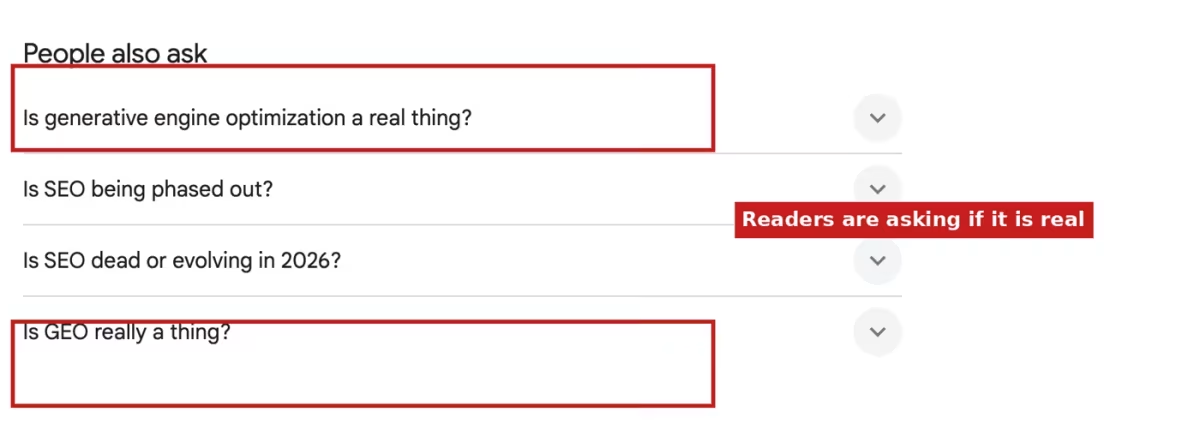
You are not the only person suspicious about this. Two of the four People Also Ask questions Google shows on this query are asking whether the category is real at all.
How is GEO different from SEO?
Mostly it is not a different discipline, it is a different surface. The retrieval that feeds an AI answer runs on the same index and the same ranking systems that produce the blue links, so the work overlaps far more than it separates.
Google says this plainly in its guide to optimizing for generative AI features: “In short, yes! The best practices for SEO continue to be relevant because our generative AI features on Google Search are rooted in our core Search ranking and quality systems.”
Google is an interested party here, since it operates the surface being optimized for. But this particular claim is one we can test against our own data rather than take on trust, and our data points the same way.
| The job | Classic SEO | What changes for AI answers |
|---|---|---|
| Getting found | Crawled, indexed, eligible for a snippet | Same requirement, plus the site has to be included in generative AI features in Search Console |
| Winning the slot | Rank high enough on the query | Rank high enough to be retrieved, then be the passage worth quoting |
| What gets lifted | A title, a snippet, sometimes a featured snippet | A self-contained answer passage, attributed with a source card |
| Structure that helps | Headings, internal links, structured data for rich results | The same, plus answering the question within 2 to 3 lines under the heading that asks it |
| Trust signals | E-E-A-T, real expertise, brand mentions across the web | Unchanged, and Google warns against chasing inauthentic mentions |
| Measurement | Position, clicks, impressions | Whether you appear in the sources panel, which is re-decided on each fetch |
That last row is the one that ended up mattering most in our test, so it is worth reading twice.
What we tested in the GEO experiment, and what we left alone
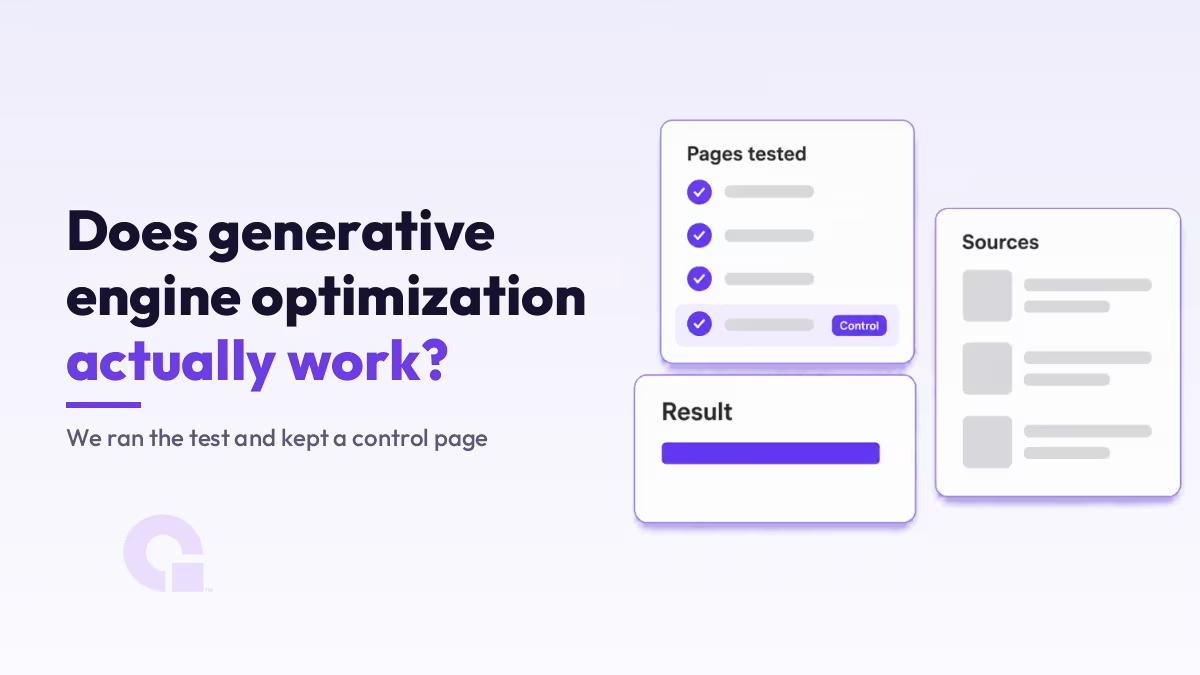
We took four of our own pages that already ranked inside the pool on their head query but were not appearing in the AI Overview’s cited-source set. Three got edited. One did not.
Here is the whole design, so you can pull it apart:
- One variable, and only one. On the three repaired pages we raised every answer passage to the highest verifiable rung of specificity: the number where a number is verifiable, the tool named rather than described, the literal on-screen string quoted rather than paraphrased, the settled mechanism phrase carried. Nothing else moved, not the title, slug, meta, images, internal links, or ranking work.
- One page held back untouched. Our post on how to fix the “URL not in property” error was the control. It had not been edited since before the study opened, and it stayed that way through every round.
- The success condition was written down first. On 12 July 2026, before a single capture existed, we declared it: a repaired page appears in the cited-source set on a later capture while the control does not. Writing it first is what removes the option of moving the goalposts once you see the data.
- Fifteen watch rounds, four markets, signed out. Every capture ran in a never-signed-in browser with the country asserted, because a personalized SERP tells you about your own account, not about the market.
- Only frames we opened by eye count. Our own capture tool reports a cited list, and we do not trust it, for reasons in the measurement section below. Every row quoted here comes from a screenshot a human looked at.
Four pages, four queries, four markets, one operator, one site, fifteen rounds. That is a single-operator case study on live pages with Google changing underneath it, not a controlled trial, and no percentage is computed from it anywhere in this article.
What the test found: the untouched control page got cited too
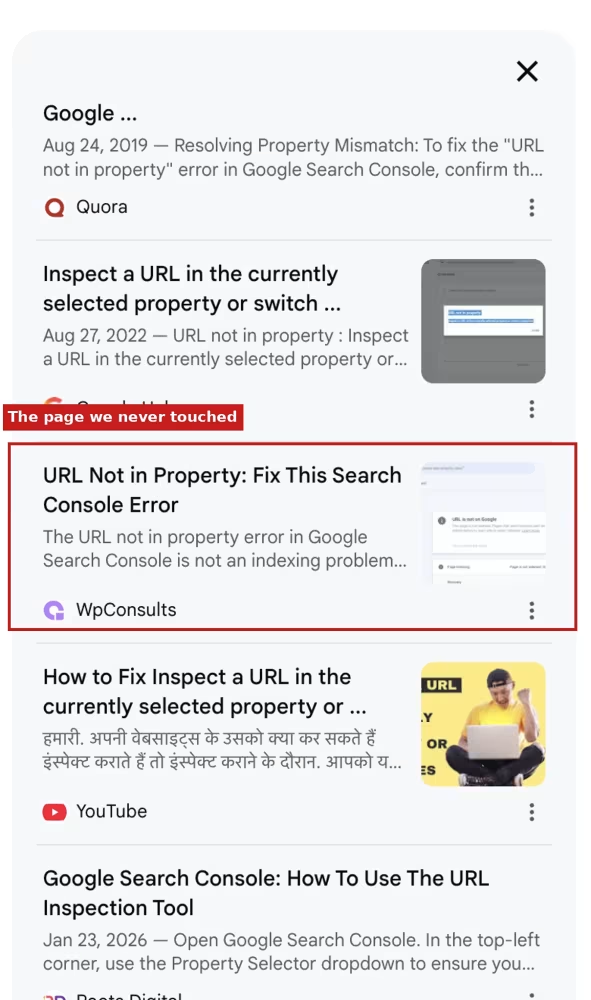
The repaired pages entered the AI Overview sources panel. So did the control. On round 12, work day 25 July 2026, on the query how to fix url is not in property, the control page has its own card in the panel, titled “URL Not in Property: Fix This Search Console Error” and attributed to WpConsults, in the United States and in Canada.
That page had not been edited since before the study opened. Both frames were opened and read by eye.
| Page | Query | Market | Nights confirmed in the panel |
|---|---|---|---|
/submit-url-to-duckduckgo/ (repaired) | duckduckgo submit url | Canada | 24, 26 and 28 July 2026 |
/submit-url-to-duckduckgo/ (repaired) | duckduckgo submit url | Australia | 26 July 2026 |
/mermaid-diagram-in-wordpress/ (repaired) | mermaid diagram wordpress | Australia | 25 and 27 July 2026 |
| The “URL not in property” post (untouched control) | how to fix url is not in property | United States, Canada | 25 July 2026 |
The pre-declared positive required the control to stay out of the panel. It did not stay out, so we cannot credit the specificity edit with anything, and we are not going to.
Twelve further frames claimed a citation that the frame cannot actually show, because the sources panel is cut off by the edge of the screenshot. Those are recorded as unknown, not as citations and not as absences.
Why an AI Overview citation looks like a slot rather than a position
Our reading is that being in the cited set, on these queries, follows from already ranking on the query plus the pool being re-decided on each fetch, rather than from the page-level specificity work we did.
That is not the answer we wanted, and it is more useful than the one we wanted, because the industry sells the opposite.
Read it next to the sister study, where a page frozen since 12 July, with Google’s served copy frozen too, was cited for four straight nights and then not cited at all.
Put the two together and the shape is consistent. A citation behaves like a slot that gets re-decided on each fetch, and the page can be identical on both sides of the change.
There is more on the diagnostic side of that in why your page is not cited in AI Overviews even though it ranks.
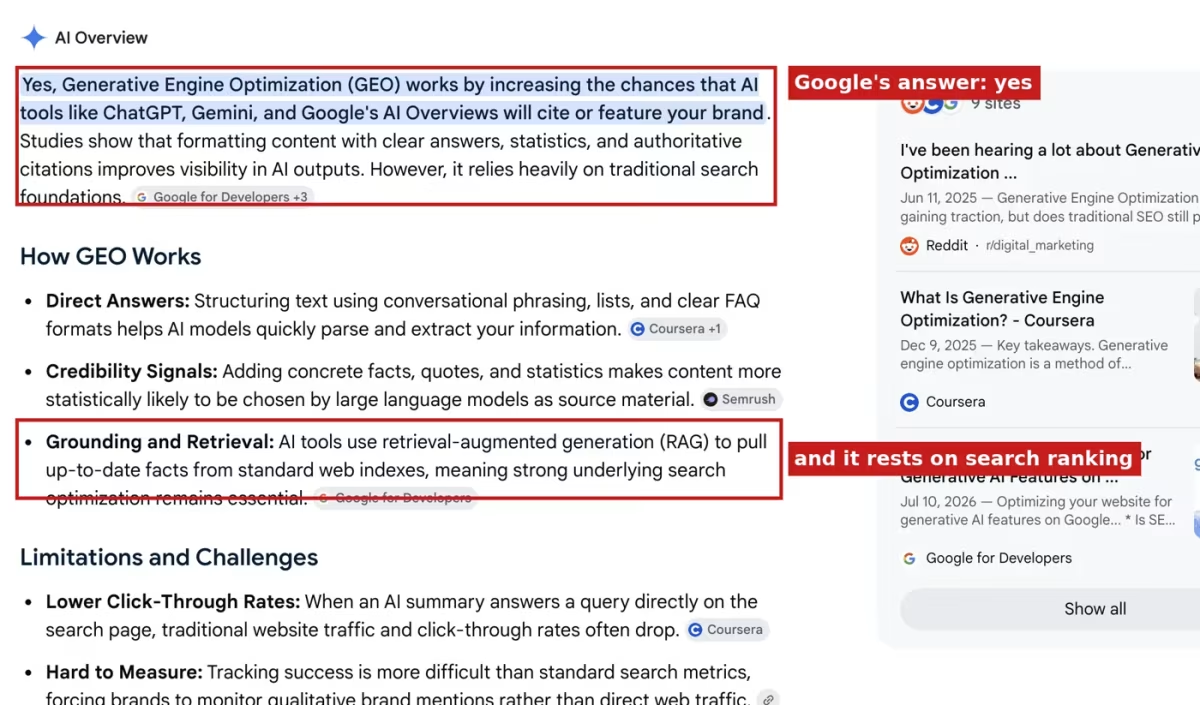
Google’s own AI Overview half concedes the mechanism. On this exact query, in the United States, signed out, it opens with “Yes” and then says GEO “relies heavily on traditional search foundations”, crediting Google’s own developer documentation for the point that AI tools pull from standard web indexes, “meaning strong underlying search optimization remains essential”.
None of this says page work is pointless. It says our test could not separate page work from the pool moving on its own, and that anyone claiming they have separated those two on a handful of pages should be asked how.
What went wrong with our own AI Overview measurement
Three faults sit behind this study, all of them ours, and all three ship with the result rather than in a footnote.
- Our capture tool’s cited list is not a faithful read of the panel. On 29 July it omitted the panel’s most prominent card on four control rows, and reported our own domain as cited on two rows where we are visibly absent. Every one of those rows was flagged as usable. That is why nothing in this article rests on a machine-read source list.
- A stored screenshot can confirm a citation and almost never refute one. The frame holds the panel’s scroll viewport, not the panel’s full list, so a card one scroll below the fold is invisible. Our “we were not cited” nights are therefore softer than we originally wrote them. A capture that needs to prove a negative has to screenshot the panel at every scroll step, and nothing in our archive does.
- Our own site counter disagreed with itself. Fetching this same query in the same market minutes apart, our tool reported a different number of cited sites on each fetch. Each individual reading matched the badge visible in its own screenshot, so the tool is not lying about any single frame; the set behind it is simply moving.
That third one is worth sitting with, because it is not only a caution about our instrument.
On the night we wrote this, we fetched does generative engine optimization work three times in the United States, signed out, within a few minutes. We got three different AI Overviews: different opening sentences, different sub-headings, different attributed sources, different counts in the sources badge. Nobody edited a page in between.
Three fetches is an observation, not a measurement, and I am labelling it as one. But it is the same shape our four pages showed us over fifteen rounds, and it is visible in about ninety seconds.
We publish our own faults in the same document as the result, because a lab that only publishes its clean nights is a marketing department.
Has anyone else run a control on this question?
One team has, on a different lever, and they landed on the same shape of answer. Seer Interactive ran a six-week test on meta descriptions and reported no measurable effect on how often AI crawled or cited their pages.
Their design is worth borrowing. They deliberately sabotaged the meta descriptions on 21 high-traffic pages, replacing 11 with a single period and 10 with a placeholder sentence, and they kept 10 untouched pages as a control group.
Every group gained AI bot traffic at nearly the same rate afterwards, including the pages nobody touched. Seer report a true effect of -1.3% once the sitewide trend is accounted for, which they describe as a statistical zero, and no citation penalty on the de-optimized pages. Their number is theirs, measured on their site with their method; we are not adding it to ours.
In their words, “seeing the control group move alongside the treatment group signaled a sitewide trend that wasn’t caused by any of our meta description changes.” That is our result, described in someone else’s data, on a completely different lever.
Here is the part I find genuinely telling. Seer’s page does not rank in the top ten for the question we are all supposedly answering. The one other team in the industry that kept a control on AI visibility is not on the SERP for it, while the pages that are on it report wins with no control at all.
How to run this test on your own pages
You do not need our tooling. You need a control page and a habit of writing the condition down first.
- Pick four pages that already rank on their head query but are not in the AI Overview sources panel. Ranking matters, because a page that is not being retrieved at all is testing a different question.
- Write the success condition down before you touch anything. Something like: page A appears in the cited set on a later capture while page D, the control, does not. Date it and save it somewhere you cannot quietly edit.
- Edit three, leave the fourth completely alone. Change one class of thing only. If you improve the answers and the internal links and the title in the same week, you have learned nothing about any of them.
- Capture signed out, with the country set. A logged-in search shows you a personalized result. Use a browser you never sign in to, and check the country Google reports at the foot of the page.
- Screenshot the sources panel at every scroll step, not just the top. This is the mistake we made. If you only capture the viewport, you can prove you were cited and you can never prove you were not.
- Run it for weeks, not days, and record the nulls. Then compare each edited page against the control, not against its own past self.
If your control moves with your edited pages, you have found a trend in the pool, not an effect from your work. That is a real finding and it is worth knowing before you sell the approach to a client.
For the measurement side, my method for reading what AI answers actually cite instead of trusting the vendor claim is in this piece on pressure-testing AI citation claims, and the coverage-rate side, how often these panels even appear for your queries, is in how often AI Overviews appear in Google Search.
So, does generative engine optimization work?
Honestly, the most defensible answer I can give from our own data is that we could not show it does, on the lever we tested, over the window we watched.
The practices are sound and I would still do them, because clear answers, verifiable facts and real expertise make a page better for a human reader whether or not a machine ever quotes it. What I will not do is promise you that a specificity pass buys a citation, because the page we never touched got one anyway.
So when the next case study lands in your feed with a big number attached, ask the one question that separates a finding from a coincidence: what did your control do?
If there was no control, all they have shown you is that a page got cited. Why it got cited is still an open question, and you should treat it that way.
Common questions about generative engine optimization
Is SEO being phased out by AI search?
No. Google’s documentation says its generative AI features are “rooted in our core Search ranking and quality systems”, so the retrieval that feeds an AI answer still runs on the search index you have been optimizing for. The surface is new, the plumbing is not.
Do I need an llms.txt file to appear in AI search?
Not for Google, which states it does not use llms.txt or similar files and that keeping one will neither help nor harm your rankings. I went through the crawler logs on this separately in does llms.txt work for SEO, and the fetch numbers say the same thing.
Does adding statistics to a page improve your AI citations?
It is the single most repeated GEO tip, and most versions of it trace back to one 2023 paper rather than to independent testing. I traced the claim back to its source in do statistics improve AI citations, which is worth reading before you rewrite a page around it.
How do I tell whether AI Overviews are actually costing me clicks?
Measure it per query rather than sitewide, because the effect is not uniform. The method I use, comparing impressions against clicks on the queries where a panel fires, is in how to measure AI Overview traffic loss.
Work with WpConsults
Want a second pair of eyes on your own AI visibility test?
If you are setting up a test like this, or you have been handed a GEO report with a big number and no control, I am happy to look at the method with you.
Want our posts to show up more often on Google?
One step & Google will surface this site in your Top Stories.