x402 Explained: How AI Agents Pay, and Why Merchants Should Care
The x402 protocol revives HTTP 402 so AI agents can pay with stablecoins over the web. How it works, where it fits, and what it means for your store.

The x402 protocol revives HTTP 402 so AI agents can pay with stablecoins over the web. How it works, where it fits, and what it means for your store.

An agentic commerce readiness checklist for your store: the identifiers, schema, feed, and protocol steps that get your products found and bought by AI agents.

ACP vs UCP compared: backers, how each sells, what they cost, and which agentic commerce protocol your store should turn on first.

ChatGPT Instant Checkout lets shoppers buy inside the chat. Here is how to get your products into ACP: eligibility, the feed steps, costs, and how to measure it.

Agentic commerce lets AI agents discover and buy for shoppers, often with no site visit. Here is the full protocol stack and what your store must do to stay visible.

“Add 15 statistics for 50% more AI citations.” Most GEO stats are mutations of one 2023 paper. Here is what the research actually measured, and how to test it on your own content.

Your map-pack rank can look healthy while AI Overviews take the local queries your tracker never checks. Here is where you are losing visibility, and how to find it.

Adding Product schema does not get your store into AI shopping baskets. Agents transact through commerce feeds like UCP and ACP. Here is what actually gates inclusion.

When an AI agent discovers, carts, and checks out through UCP, your product page never renders. The ranking surface moves from your HTML to your feed. Here is the operator playbook.

Two AI Overview narratives both circulating: “AIO destroys traffic” and “get cited and win more clicks.” Both are true for different queries. Here is how to measure which one applies to yours.

llms.txt is sold as an AI-visibility must-have. Across 515 million AI bot requests it was touched 408 times, and Google says it does not use it. Here is the one case where it earns its place.

The schema-for-AI pitch is mostly fiction. The data shows near-zero citation lift; here is what actually drives AI visibility, and how to test it yourself.

GA4 cannot see AI crawlers because they do not run JavaScript. Your raw server logs can. Here is the cross-reference audit that separates training bots from retrieval agents, kills spoofed traffic, and exposes crawl-budget waste.

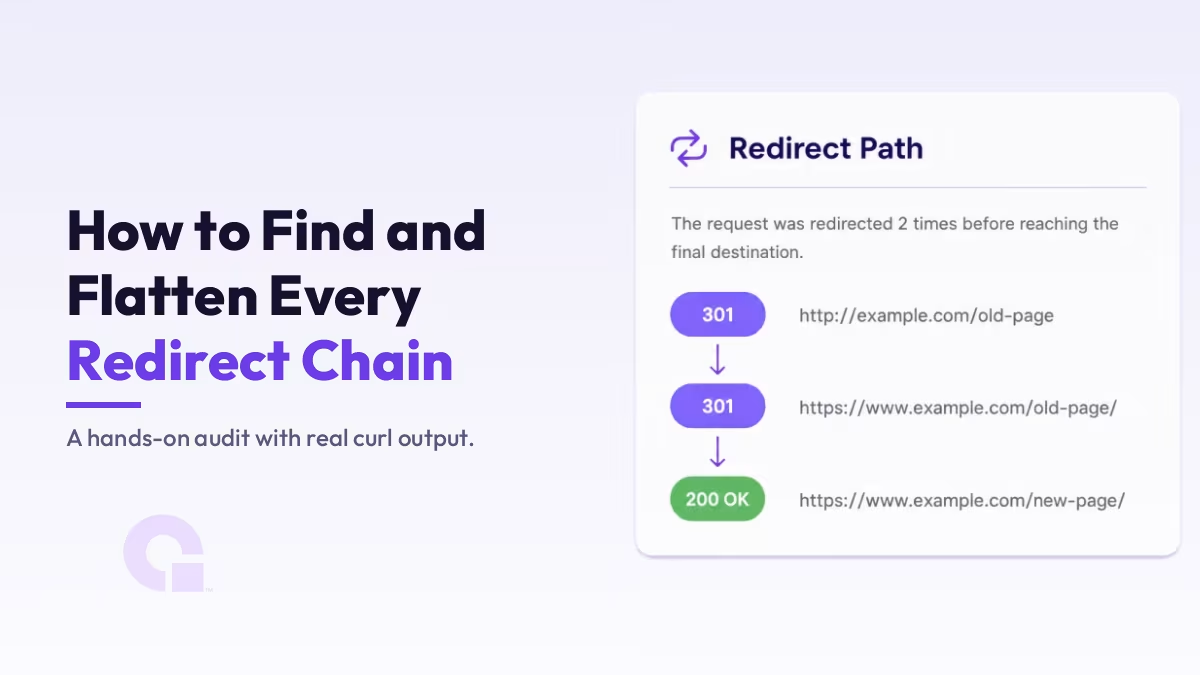
A plain-English guide to redirect status codes: what 301, 302, 307, 410, and 451 each do, when to use them, and exactly how each one affects your SEO.

Googlebot only reads the first 2MB of your page. Here is what the Googlebot 2MB limit means for your SEO and how to keep your key signals within reach.

Google patented a system that fakes ranking changes to catch manipulative SEOs. Here is how the Rank-Modifying Spammers patent works, and how not to fall for the fake ranking trap.
We use cookies to improve your experience on our site. By using our site, you consent to cookies.
Manage your cookie preferences below:
Essential cookies enable basic functions and are necessary for the proper function of the website.
These cookies are needed for adding comments on this website.
Google Tag Manager simplifies the management of marketing tags on your website without code changes.
These cookies are used for managing login functionality on this website.
Statistics cookies collect information anonymously. This information helps us understand how visitors use our website.
Google Analytics is a powerful tool that tracks and analyzes website traffic for informed marketing decisions.
Service URL: policies.google.com (opens in a new window)
Clarity is a web analytics service that tracks and reports website traffic.
Service URL: clarity.microsoft.com (opens in a new window)
You can find more information in our Cookie Policy and Privacy Policy.