Page one for “long tail keywords ai overviews” says the same thing nine times over: long-tail queries trigger AI Overviews more often, so move your keyword budget to the tail. That advice rests on a count of how often the AI Overview appears, then answers a question about who gets cited inside it.
We ran a 21-query ecommerce test set across four markets and six rounds, 503 measured searches in all, to separate the two questions. The AI Overview appeared on every single search, the number of sources it cited did not reliably grow on the tail, and the real change was that big brands dropped out of the cited sources while small independent sites took their place.
Key Takeaways
- Long-tail queries do trigger AI Overviews more often across broad keyword samples. Ahrefs’ study of 300,000 keywords puts the median AI Overview keyword at 4 words against 2 words for keywords with no AI Overview.
- Triggering and being cited are two different measurements. The widely repeated “twice the rate” figure comes from a study that counted how often the feature appeared, not how often a site got cited.
- On our 21-query ecommerce test set the AI Overview appeared on 503 of 503 usable searches, which is 100%, including every near-zero-volume long-tail query in all four markets.
- The number of sources cited did not grow as queries got more specific. Of three matched head-to-tail pairs, one widened in all six rounds, one narrowed in all six, and one closed at exactly zero.
- What does change is who gets cited: small independent sites take 16 to 25 more points of citation share on long-tail queries than on head terms, at every authority threshold we tested.
- The mechanism is that big-brand share of citations falls from about 40% on head queries to 12 to 14% on long-tail queries, so big brands stop competing there.
- Long-tail queries also change their cited sources the most between checks, so a citation you win there can disappear within days.
Do long-tail keywords actually get you cited in AI Overviews?
Long-tail keywords did not get us cited more reliably than head terms on the ecommerce queries we tested. Long-tail queries do trigger AI Overviews more often across broad keyword samples, and that half of the advice holds up. What does not follow is that the pool of cited sources opens up once the AI Overview has appeared.
There are two separate questions buried inside “go long-tail for AI visibility”, and almost nobody splits them.
- Does the AI Overview appear at all? This is the trigger question, and it is the one every published study I can find actually measures, because it is cheap to measure at scale.
- Once it appears, can you get into the cited set? This is the citation question, and it is the one that decides whether your store gets anything out of the strategy. It costs far more to measure, because you have to open the sources panel on every query and read what is in it.
The whole first page measures question one and then answers question two as if the answer carried over. On our ecommerce queries, question one turned out to be moot, because the AI Overview appeared on all of them, and question two did not go the way the advice promises.
If you want the coverage-rate side on its own, I wrote that up separately in how often AI Overviews appear in Google Search, which is a different question from this one and answers it with different numbers.
What the “twice the rate” claim about long-tail keywords actually measured
The “twice the rate” figure measured how often an AI Overview appeared, and it then got restated as how often a site got cited. Those are two different numbers, and the swap happens between one article’s headline and its own second sentence.
Here is the trail. The xSeek article on long-tail versus short-tail keywords, published on July 9, 2026, carries this line in its meta description and in its own Google snippet:
Long-tail keywords earn 2x more AI Overview citations than short-tail.
One paragraph into the body of that same article, the source for the claim is stated plainly, and it says something else:
According to a 2024 SE Ranking study analyzing 100,000 queries, long-tail phrases (4+ words) triggered AI-generated summaries at roughly twice the rate of one- or two-word head terms (SE Ranking, 2024).
Read those two lines against each other. The cited study counted how often the summary appeared. The headline counts how often a site is cited inside it.
I have not read the SE Ranking report first-hand, so I am quoting it only as xSeek reports it, and you should treat it the same way.
The part I did not expect is that Google repeats the swap in its own AI Overview for this query, under a heading that still says “trigger”.
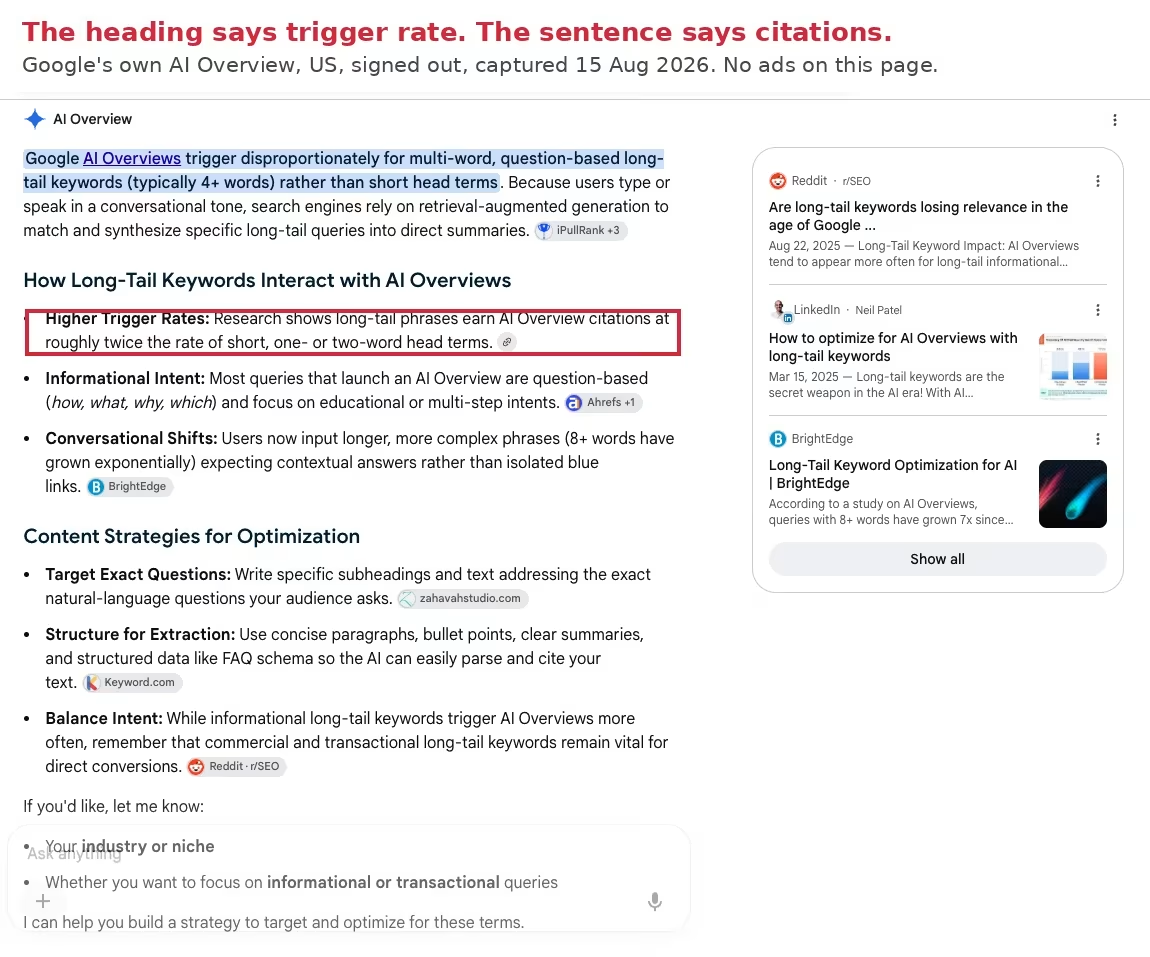
The bullet reads: “Higher Trigger Rates: Research shows long-tail phrases earn AI Overview citations at roughly twice the rate of short, one- or two-word head terms.” In our capture that bullet carried no source chip at all, so I am not attributing it to any vendor.
Two results further down the same page, the swap is visible side by side.
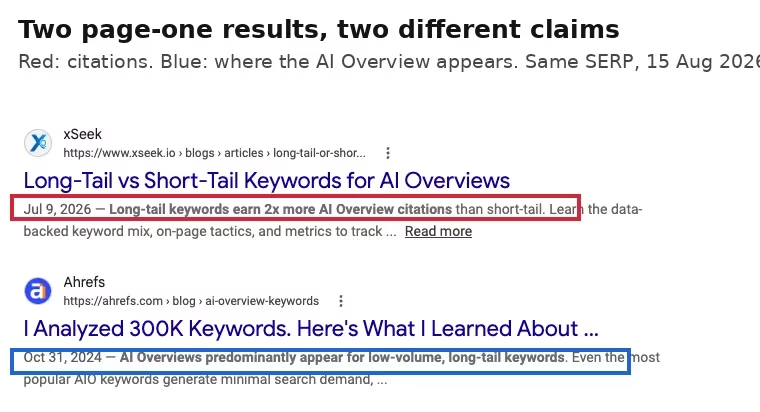
Every vendor in this conversation sells a product whose value depends on AI visibility being measurable and improvable. That does not make them wrong, and BrightEdge, Ahrefs, SE Ranking and xSeek all did work nobody else had done. It does mean you check what a number counted before you plan around it.
How we measured citations across an ecommerce query ladder
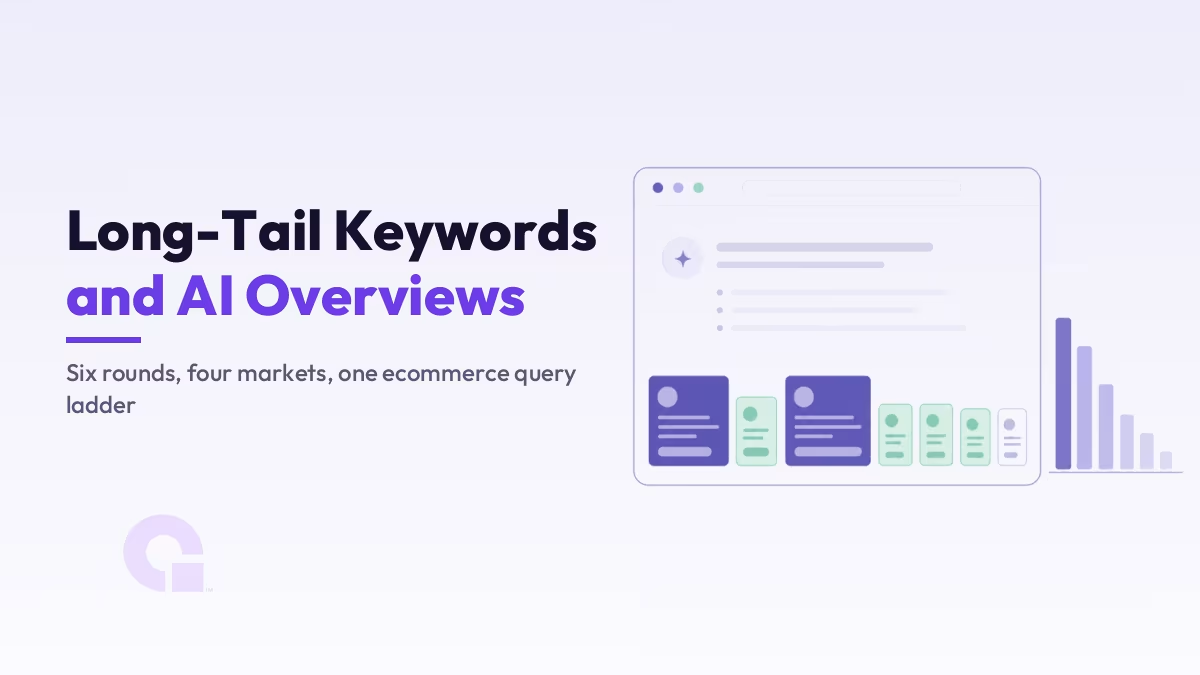
We built a query ladder, meaning 21 ecommerce searches arranged from broad head terms at the top down to very specific long-tail phrases at the bottom. We then captured the AI Overview and its full sources panel for every query, in four markets, six times over a 17-day window.
That is 21 queries times 4 markets times 6 rounds, so 504 designed searches and 503 usable ones. The full write-up lives on this site as Query Competitiveness and Citation Source Composition in Google’s AI Overviews, and the preprint is deposited on Zenodo under CC BY 4.0 at doi.org/10.5281/zenodo.21923520, with all 504 screenshots, the raw data rows and the analysis scripts attached.
Here is the full scope, because that is the part that gets dropped when a figure gets quoted somewhere else.
- 503 usable searches across 21 queries, so this is a designed field study on one industry, not a population estimate for search as a whole.
- Four markets: the United States, Canada, the United Kingdom and Australia. Each market is reported as its own row and never merged into one average, because merging them hides the differences that make a four-market design worth running.
- Six rounds over 17 days, captured signed out, so one odd result on one day cannot become a finding on its own.
- One operator and one instrument. Everything was captured by the same person with the same tool, which keeps the method consistent and also means nobody has independently reproduced it.
Three matched head-to-tail pairs were built into the ladder by design, so the head and the long-tail version of each pair ask the same commercial question at two levels of specificity. That is what makes a head-versus-tail comparison honest rather than a comparison of two unrelated topics.
Did the AI Overview appear on every ecommerce query we tested?
Yes, on every one. The AI Overview appeared on 503 of 503 usable searches, which is 100%, in all six rounds and all four markets, including every near-zero-volume long-tail query on the ladder.
We had pre-declared the opposite. The expectation written down before capture started was that the feature would skip long-tail and frontier ecommerce queries, and that expectation is falsified. It is published as falsified in the paper rather than quietly dropped, because a null result you hide is worth nothing to anyone.
This matters for the advice, and it matters in a boring way: if the AI Overview appears on the head and the long tail alike, “the tail triggers it more” is not a reason to move your keyword budget.
Our 100% sits awkwardly next to the best-known figure on this topic, so it is worth saying exactly what that figure counts. Louise Linehan Louise LinehanContent Marketer, AhrefsContent marketer at Ahrefs and author of its 2024 data study analyzing 300,000 keywords to identify what triggers Google AI Overviews.Ahrefs author pageLinkedIn analyzed 300,000 keywords for Ahrefs in a study published on October 31, 2024.
The body of that study says commercial and transactional keywords made up under 10% of the AI Overview keywords analyzed, at 5.8% and 4.0% respectively. Its own summary bullet phrases the same thing as a 10% chance of an AI Overview showing for those keywords, which is a different measurement again.
Share of a keyword set and chance of appearing are not interchangeable, so I am using the body version here, because that is the one the study’s own intent chart supports.
Our test set is mostly commercial-investigation queries, phrases like “shopify vs woocommerce” and “best ecommerce platform”, and the AI Overview appeared on all of them. Two honest explanations sit alongside each other, and I would not pick between them without a test.
- The samples are different. Ahrefs analyzed the most-searched keywords across all of search; we ran a hand-built ecommerce set that deliberately includes very low-volume long-tail phrases. Different populations give different rates, and neither one is the “real” number.
- The dates are different, and this is the bigger factor. The Ahrefs capture window was late 2024 and ours was mid-2026, about 22 months apart. AI Overview coverage expanded a lot in between, and that article itself says the metrics will vary by keyword category and encourages you to run the analysis on your own terms.
That honesty about scope is the right instinct, and it is why the Ahrefs study still holds up almost two years later while a lot of the pages quoting it do not.
Does the cited pool get bigger on long-tail queries?
The cited pool did not reliably get bigger. Across three matched head-to-tail pairs measured six times each, the number of cited sources went three different ways: one pair widened every single round, one narrowed every single round, and one closed at exactly zero after changing direction twice.
| Matched pair (head to long tail) | Direction across six rounds | Closing change in the number of cited sources |
|---|---|---|
| “shopify vs woocommerce” to “shopify vs woocommerce for a small uk clothing brand” | Widened in all 6 rounds | +4.5 sources |
| “how to reduce cart abandonment” to “how to reduce cart abandonment on a one-product store” | Narrowed in all 6 rounds | -2.2 sources |
| “best ecommerce platform” to “best ecommerce platform for a handmade candle business” | Changed direction twice (+1.8, -0.2, -0.5, -2.8, +2.0, 0.0) | 0.0, which is noise |
That third row is the one I would point at if someone asked me why single-round citation studies should be read carefully. Measured once in round four, that pair looks like clear evidence the long tail shrinks the pool. Measured once in round five, it looks like clear evidence it widens it.
So a page claiming the long tail gives you a bigger citation pool has almost certainly measured one query pair. We measured three, and two of them go the other way.
It is worth knowing how big that pool is at any point on the ladder. Each round returned between 200 and 332 different websites in total, and an individual AI Overview cited anywhere from 2 to 15 sources.
The five most-cited platforms took between 25% and 32% of all citations in a round, so the rest is spread widely. We built the study to test whether small sites are shut out at the head of the ladder, and they are not: even on broad head terms the cited set draws from hundreds of different websites.
Who leaves the AI Overview citation pool as a query gets more specific
Big brands leave. Small independent sites take 16 to 25 more points of citation share on long-tail queries than on head terms, and that lift holds at every authority threshold we tested.
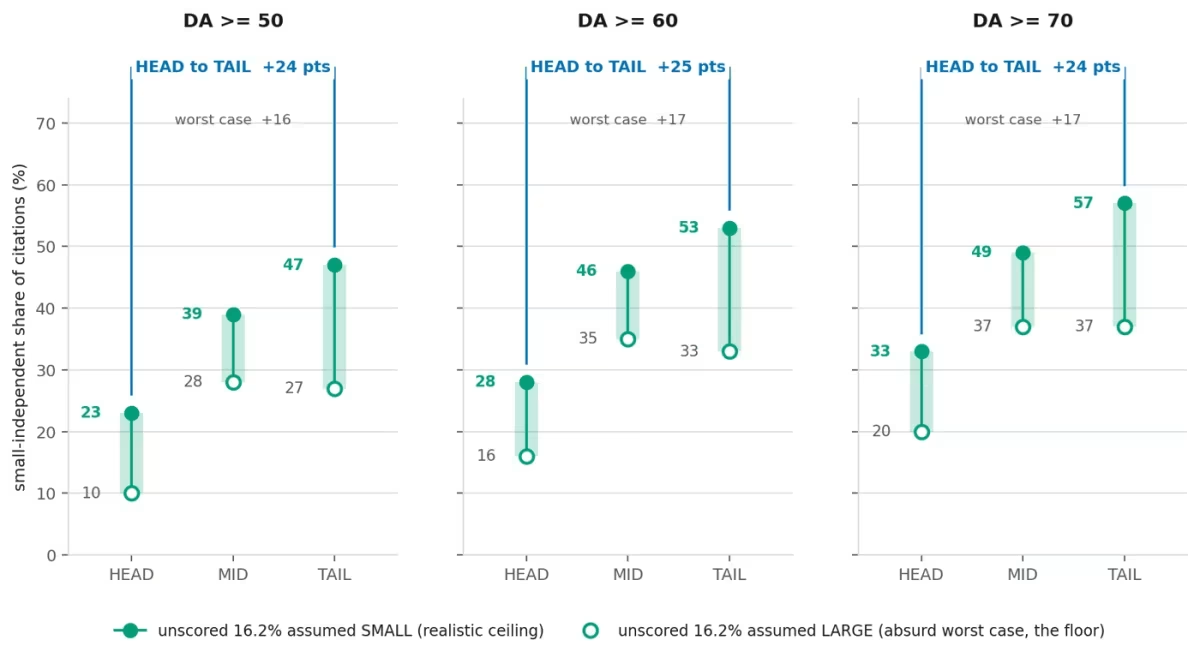
The rule behind that chart is a numeric domain authority score rather than a hand-picked list, which matters because deciding by hand which sites count as “big brands” would just be my judgment with a percentage attached.
We scored 200 of the 667 cited root domains for domain authority, and those 200 cover 3,602 of 4,298 citations, or 83.8%. For the domains we could not score, we ran the numbers twice, once assuming every one of them was small and once assuming every one was large, and the small-site lift stays positive in both.
Breaking it down in the two rounds where we recorded the full three-way split shows the mechanism. Big-brand share of citations falls from roughly 40% on head queries to 12 to 14% on long-tail queries, while the share taken by very large platforms like YouTube and Reddit stays roughly flat.
So the defensible sentence is that big brands stop competing on long-tail queries. The sentence I keep seeing instead is that small sites win more out there, and I am not writing that one, because it flatters the reader and our own data does not support it.
That difference changes what you should plan for. A competitor dropping out of a citation slot does not put you in it, and the next two sections are about what it costs to get in and stay in.
Do AI Overview citations mostly come from outside the top 10 organic results?
About half of the cited websites on our test set came from outside the organic top 10. In round six, 52% of the websites cited by the AI Overview also ranked in the organic top 10, and across the six rounds that figure ran 41, 40, 42, 48, 54 and 52%.
So between 46% and 60% of cited websites sat outside the top 10, depending on the round. BrightEdge publishes a much higher figure, and the comparison needs care.

BrightEdge states that 89% of AI citations come from outside the top 10 organic results. That counts citation instances. Ours counts distinct cited websites, so a site cited on ten different queries is one entry in our figure and ten in a count of instances.
Those are different denominators, and I am naming that instead of treating the two as interchangeable, because treating them as interchangeable is the exact mistake this whole article is about.
Even allowing for it, the gap is wide. Our 46% to 60% for cited websites sits well below BrightEdge’s 89% for citation instances, ours comes from a described 21-query ecommerce set in four markets with downloadable rows, and the BrightEdge sample is not described on that page.
A second sample of ours points the same way. In our SEO practitioner lane, 39% of cited websites ranked in the organic top 10 across 15 queries and 99 citations, so 61% sat outside it.
That is further out than the ecommerce figure and still a long way short of 89%. We keep those two lanes separate and never pool them into one number, because they were captured to check each other rather than to be averaged.
You can see the effect on a single search without any of our data. When I ran this article’s own query, “long tail keywords ai overviews”, signed out in the United States on August 15, 2026, three of the eleven cited websites, iPullRank, 20North Marketing and Keyword.com, did not appear anywhere on page one.
That is one search rather than a rate, and it shows the same effect the six-round series measures. If you want to run that check on one of your own URLs, the step-by-step version is in why your page is not cited in AI Overviews even though it ranks.
How stable is an AI Overview citation once you get one?
An AI Overview citation is less stable than a ranking, and least stable on long-tail queries. Comparing each query and market combination against itself from one round to the next, the mean overlap between the two cited sets ran between 0.43 and 0.59, on a scale where 1.0 would mean an identical list of sources.
In plain terms, roughly half the cited sources on a given query changed between one capture and the next, a few days apart, with nothing changing on anyone’s website.
Long-tail queries were the least stable in all five of the churn measures we ran. So the honest version of “you can get cited on long-tail queries” is that you can get cited on Tuesday and not on Friday, and a strategy built on it needs ongoing work.
One thing held remarkably steady through all that churn, and it is the most useful single finding here for a store owner. YouTube appeared in 18 to 21 of the 21 queries in every round. In round six the steady group was YouTube in 20 queries, Reddit in 16, shopify.com in 12 and Quora in 8.
I want to be careful with this read, though, because six rounds is where I am least comfortable. Churn is exactly the measure that would benefit most from eight rounds or ten, and we ran six.
What our AI Overview citation study cannot tell you
Quite a lot, and these are the limits of our 503-search ecommerce study that I would raise first if I were reviewing it for somebody else.
- Six rounds, not eight. That is enough to show the pool-size null result and the composition change, and it bears hardest on the churn figures, where more rounds would tighten the picture.
- One industry. Everything here is ecommerce. Whether the same shift in who gets cited holds in local services, health or B2B is an open question, and I would not assume it does.
- One operator and one instrument. Nobody has reproduced this independently, which is the normal state for a first study and still a real limit.
- Google’s Shopping module was never measured. We did include queries about AI shopping assistants, but the flag that would have recorded whether a Shopping module appeared alongside the AI Overview was never emitted by our capture tool in any round. That measure is missing rather than zero, and no claim about Shopping modules appears anywhere in this piece.
- Some results depend on the tool’s reading of the cited list. That dependency is named result by result in the paper’s own limitations, so you can see which findings rest on it and which do not.
We also corrected ourselves twice before publishing, and both corrections came from an internal audit rather than from a critic. One pair was described as changing direction five times when a count against the actual series showed two, and the YouTube figure read “19 to 21 of 21” when the per-round entries record 18 in two rounds.
Neither error changed a conclusion, and both are recorded in the paper itself. Count it before you report it, and that applies to us as much as to anyone we are quoting.
What should a store owner actually do about long-tail keywords?
Keep writing for long-tail queries, but change your reason for doing it and change what you expect back. Your odds of being cited are roughly the same at both ends of the ladder; what changes is who else is competing for the slot.
- Stop expecting more citation slots on long-tail queries. Our three matched pairs disagree with each other on how many sources get cited, so nobody can promise you a bigger cited set out there, and a plan that depends on one is resting on a number that changed sign twice in our own series.
- Go long-tail because the big brands are not there. Their share of citations falls from about 40% to 12 to 14% as queries get specific, and that is a real and large change in who you are competing with for the same slot.
- Budget for keeping the citation, not just for earning it. Roughly half the cited sources changed between captures a few days apart, so plan to re-check and refresh the page that earned it, and do not book the citation as a permanent win.
- Put real effort into video and community, because those held steady through the churn. YouTube was cited in 18 to 21 of our 21 queries in every round, with Reddit, shopify.com and Quora behind it. A store with nothing on any of those surfaces is missing the most durable part of the cited set.
- Keep one strong owned page per topic and maintain it. The cited set draws from 200 to 332 different websites in a single round, so ranking is not the gate people assume. Being easy to quote is a separate job, and I covered how that works in how to optimize for Google AI Overviews.
- Answer the question within two to three lines under the heading that asks it, then expand. Google’s AI Overview quotes a single passage from a page rather than the whole page, so put the complete answer in one place where it can be lifted out.
- Check your own Search Console before you copy any of this. Compare impressions on your question-shaped queries against your commercial ones, because your own numbers matter more here than anybody’s published average, including ours.
One thing I would skip: the FAQ schema advice that page one keeps repeating, and that Google’s own AI Overview repeats back at you. Google restricted FAQ rich results to well-known government and health sites in 2023, so on a store that markup earns you nothing in the search result.
Writing the questions and answering them properly is still worth doing. The schema code wrapped around them is the part that stopped earning anything.
If you are working on the ecommerce side of this, the companion piece on what ranking ecommerce category pages do with their text covers the same reader from the ranking angle, and what AI visibility tools actually measure is worth reading before you pay for anything that promises to track this for you.
So, are long-tail keywords still worth chasing for AI Overviews?
Long-tail keywords are still worth chasing, and for a different reason than the one you have been given. The long tail is worth your time because your biggest competitors have largely stopped showing up there, not because Google hands out citations more freely once the query gets specific.
Honestly, the version of this advice circulating right now is the more attractive one, and that is exactly why it spread. “The pool opens up on the tail” tells a small store it can win by being small.
Across our 503 searches the number of cited sources stayed about the same from head to long tail, while small independent sites picked up 16 to 25 more points of citation share. That is a smaller promise and a more useful one, because it tells you who you are actually up against.
The strategy barely changes. What changes is what you expect from it, and expecting the right thing is what stops you giving up in month three when the citation you won in week two quietly disappears.
If you want the full method, the bounds tables and the sensitivity analysis behind everything above, they are in the research paper this article is built on. And if you want to see the other side of this tested rather than argued, we ran a controlled version with an untouched control page, and the control got cited too: does generative engine optimization work.
Common questions about long-tail keywords and AI Overviews
What counts as a long-tail keyword?
A longer, more specific search phrase, usually four or more words, that describes a narrow need rather than a broad category. Ahrefs’ 300,000-keyword study puts the median keyword that triggers an AI Overview at 4 words, against 2 words for keywords that do not.
Are long-tail keywords better than short-tail keywords?
They are easier to compete for and they convert better, because the intent behind them is clearer. Ahrefs measured a median keyword difficulty of 12 for AI Overview keywords against 33 for the rest, and 13 referring domains needed to rank against 41. They also carry far less search volume, so you need many of them to add up.
Does FAQ schema help you get cited in AI Overviews?
There is no evidence it does, and the rich result it used to earn is gone for most sites. Google limited FAQ rich results to well-known government and health sites in 2023, so on a store the markup itself is not doing work. Write and answer the questions anyway, because the answer is what gets quoted.
How do I check whether my own pages are cited in AI Overviews?
Run your target query signed out, expand the AI Overview, open its sources panel and scroll it to the end before you read it, because the panel loads more sources as you scroll. Repeat it a few days later, since roughly half the cited set changed between our own captures a few days apart.
Work with WpConsults
Want to know where your store actually stands in AI search?
I will run your own queries, open the sources panel on each one, and tell you which surfaces are carrying your category and which ones you are missing.
Update Logs
15 Aug 2026
- First published, built on our own 503-search ecommerce study now deposited on Zenodo, plus first-hand captures of Google’s AI Overview for this query and of the BrightEdge and Ahrefs pages it cites.
Want our posts to show up more often on Google?
One step & Google will surface this site in your Top Stories.