
Difference between 301, 302, 307, 410, & 451 redirects. (SEO Perspective).

If you’ve ever moved a page, changed a URL, or deleted old content on your website; you’ve probably dealt with redirects. But here’s the problem; most people just slap a 301 on everything and call it a day.
That’s a mistake. Different situations call for different redirect types; and using the wrong one can quietly drain your SEO rankings without you even realizing it.
In this guide, I’m going to explain every major redirect and status code you’ll encounter; what each one does, when to use it, and how it affects your SEO. Simple enough that a complete beginner can follow along.
Let’s get into it.
What Actually Happens When You “Redirect” a URL?
Before we dive into the specific codes, let’s understand what a redirect actually is.
When someone (or Google) tries to visit a URL on your website, your server sends back a response. That response includes a status code; a three-digit number that tells the browser or search engine what’s going on.
If the status code starts with a 3 (like 301, 302, or 307), it means the content has moved somewhere else, and the server is telling the visitor where to go instead.
If the status code starts with a 4 (like 410 or 451), it means the content is gone and there’s no new location to go to.
That’s it. Redirects are just your server’s way of saying “this page isn’t here anymore; go look over there” or “this page is gone for good.”
Now let’s break down each code.
What Is a 301 Redirect and When Should You Use It?
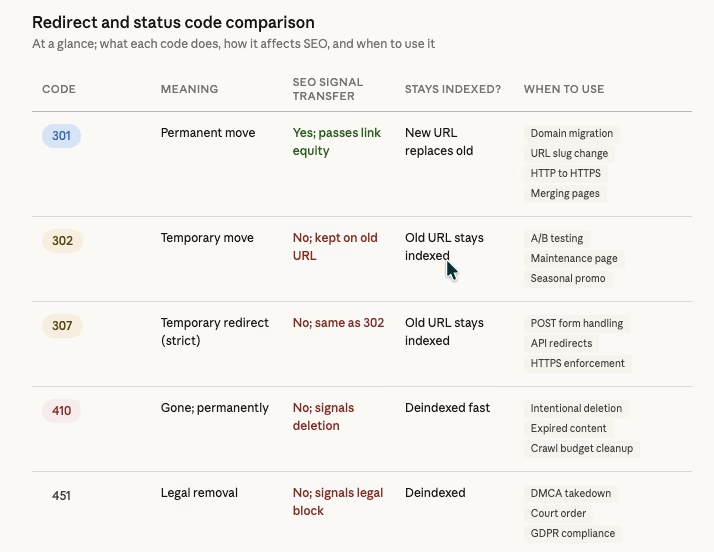
A 301 redirect means “permanently moved.” It tells browsers and search engines that the old URL has been replaced by a new one; forever.

This is the most common redirect you’ll use, and it’s the one that matters most for SEO.
What happens to your SEO with a 301:
When you set up a 301, Google transfers the ranking signals (often called “link juice”) from the old URL to the new one. That includes backlinks, authority, and trust. It’s not a perfect 100% transfer; there’s always a small amount of signal loss. But it’s the closest thing you’ll get to keeping your rankings intact when a URL changes.
When to use a 301:
- You changed a page’s URL slug (for example, from /old-post to /new-post)
- You moved your entire site to a new domain
- You switched from HTTP to HTTPS
- You merged two pages into one
- You restructured your site’s URL format
- You consolidated www and non-www versions of your site
Think of a 301 as a permanent change of address. You moved house, you’re never going back, and you want all your mail forwarded to the new place.
For a deeper dive into practical scenarios, check out our guide on proper use cases for 301 and 302 redirects.
What Is a 302 Redirect and Why Does It Confuse Google?
A 302 redirect means “temporarily moved.” It tells search engines that the page has moved to a different URL; but only for now. The original URL will come back eventually.
Here’s the key difference from a 301; with a 302, Google keeps the old URL in its index. It doesn’t transfer ranking signals to the new URL because it expects the original to return.
What happens to your SEO with a 302:
Google continues to index the original URL. If you accidentally use a 302 when you meant to use a 301, your old URL stays in search results while the new one gets ignored. You end up with two URLs competing against each other; or worse, the wrong one ranking.
This is one of the most common SEO mistakes. People use 302 redirects for permanent changes because they don’t know the difference; and then wonder why their new URL never ranks.
When to use a 302:
- You’re running an A/B test on a landing page
- A page is temporarily under maintenance
- You’re showing a seasonal or promotional page that will revert later
- You need to redirect users temporarily while you fix something
Think of a 302 as putting a “temporarily closed for renovation” sign on your shop. The shop is still yours; you’re just sending customers next door while you repaint.
Important warning: If a “temporary” redirect stays live for months; Google may eventually start treating it like a 301 anyway. But you’re leaving it up to Google to guess, and that’s never a good strategy.
What Is a 307 Redirect and How Is It Different From a 302?
A 307 redirect also means “temporarily moved,” just like a 302. So why does it exist?
The difference is technical. With a 302, older browsers and servers sometimes changed POST requests into GET requests during the redirect. That could cause issues with form submissions and API calls. A 307 was introduced to fix this; it guarantees that the HTTP method stays the same during the redirect.
What happens to your SEO with a 307:
From an SEO perspective, a 307 behaves exactly like a 302. Google treats both of them as temporary redirects. The original URL stays indexed; no ranking signals transfer to the new URL.
When to use a 307:
- You need a temporary redirect and your site handles POST requests (like form submissions or payment processing)
- You’re working with APIs and need to preserve the original HTTP method
- Your server or application framework automatically uses 307 for HTTPS enforcement
For most website owners running a standard WordPress site; you’ll rarely need to set up a 307 manually. It’s more relevant for developers working with web applications. If you’re not sure whether to use 302 or 307, go with 302 for simplicity.
What Is a 410 Status Code and Why Is It Better Than a 404?
A 410 is not technically a redirect. It’s a status code that means “gone; permanently.”
Unlike a redirect, a 410 doesn’t send users or search engines to a new URL. It simply says “this page used to exist, but it’s been intentionally removed and it’s never coming back.”
How is a 410 different from a 404?
A 404 means “not found.” It could mean the page never existed, or the URL was typed wrong, or the page was accidentally deleted. Google doesn’t know why it’s missing; just that it’s not there.
A 410 is a stronger, clearer signal. It tells Google “we deliberately removed this content. Stop looking for it. Stop crawling this URL. Remove it from the index.”
What happens to your SEO with a 410:
Google deindexes the URL faster than it would with a 404. With a 404, Google might keep checking back for weeks or months; hoping the page returns. With a 410, Google takes the hint quickly and moves on.
This is especially important for large sites. If you have hundreds or thousands of deleted pages returning 404 errors; that’s wasted crawl budget. Googlebot keeps revisiting those dead URLs instead of spending time on your actual content. Switching those to 410 tells Google to stop wasting time.
When to use a 410:
- You intentionally deleted a page or post and there’s no replacement
- You removed outdated content that’s no longer relevant (expired promotions, discontinued products)
- You want Google to deindex a URL as fast as possible
- You’re cleaning up your site and want to free up crawl budget
What Is a 451 Status Code and When Would You Ever Need One?
A 451 means “unavailable for legal reasons.” It’s a niche status code; but an important one.
This code tells search engines that the content has been removed because of a legal requirement. It could be a court order, a DMCA takedown, government censorship, or compliance with data privacy regulations like GDPR.
What happens to your SEO with a 451:
Google treats a 451 similarly to a 410; it will deindex the URL. But the 451 gives additional context about why the content was removed. Google can log the legal reason, and in some cases, it may display a notice in search results that the content was removed due to a legal complaint.
When to use a 451:
- You received a DMCA takedown notice for specific content
- A court order requires you to remove certain pages
- Content must be blocked in specific regions due to local laws
- You need to comply with a GDPR right-to-be-forgotten request
Most small business websites will never need a 451. But if you ever face a legal content removal situation; this is the proper way to handle it.
Does Using the Wrong Redirect Actually Hurt Your Rankings?
Yes. And it happens more often than you’d think.
Here are the most common mistakes and how they damage your SEO:
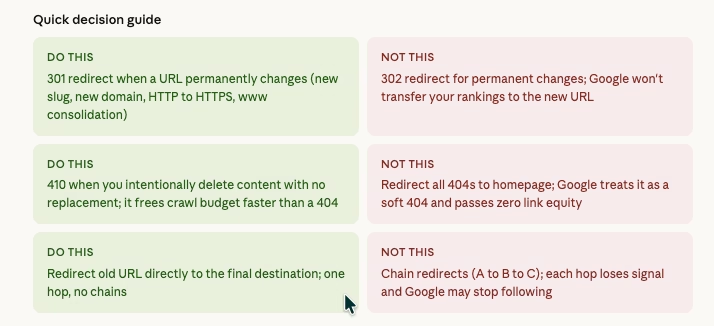
Using a 302 when you need a 301: Your old URL stays in Google’s index. Your new URL doesn’t get the ranking signals. You lose traffic gradually and can’t figure out why.
Redirect chains (A redirects to B, B redirects to C): Every hop in a redirect chain causes a small amount of signal loss. After two or three hops, Google might just stop following the chain entirely. Always redirect directly from the old URL to the final destination.
Redirecting everything to the homepage: Google sees this as a soft 404. It doesn’t pass ranking signals because the homepage isn’t a relevant replacement for the specific page. Your rankings disappear.
Leaving 404s when you should use 301s or 410s: If you deleted a page that had backlinks, those links are now pointing to nothing. That’s wasted authority. Either redirect to a relevant page (301) or confirm the deletion (410).
Not redirecting HTTP to HTTPS: If both versions of your site are accessible, you have a duplicate content problem. Google doesn’t know which version to rank. Always 301 redirect HTTP to HTTPS.
How Do You Set Up Redirects in WordPress?
There are several ways to implement redirects in WordPress, depending on your comfort level.
Using a plugin is the easiest option for most people. Plugins like Rank MathThis site use affiliate links to promote recommended product and services, Yoast Premium, or the Redirection plugin let you manage all your redirects from the WordPress dashboard. You can choose the redirect type, set the source URL, and define the destination; all without touching code.
Using your .htaccess file is more direct. If you’re comfortable editing server files, you can add redirect rules to your .htaccess file. This is faster because the redirect happens at the server level before WordPress even loads. But a mistake in .htaccess can break your entire site; so always back up first.
Using your hosting panel is another option. Many hosts like Cloudflare, Kinsta, and SiteGround, HostingerThis site use affiliate links to promote recommended product and services offer redirect management in their dashboards.
No matter which method you choose; always test your redirects after setting them up. Use a tool like httpstatus.io or the Redirect Checker in Screaming Frog to verify that the correct status code is being returned.
FAQ: Redirect Questions Every Website Owner Asks
Should I redirect all my 404 pages to the homepage?
No. This is a very common mistake. Google treats mass redirects to the homepage as “soft 404s.” That means Google recognizes that the homepage isn’t a real replacement for the missing page; so it won’t pass any ranking signals. The redirect essentially does nothing for your SEO. Instead, redirect each 404 to the most relevant existing page on your site. If no relevant page exists, use a 410 to tell Google the content is permanently gone.
Should I redirect HTTP to HTTPS?
Yes; always. If your site is accessible on both http:// and https://, you have a duplicate content problem. Set up a site-wide 301 redirect from HTTP to HTTPS. This ensures all your ranking signals consolidate on the secure version. Most WordPress hosts make this easy; some even do it automatically.
Should I redirect www to non-www (or the other way around)?
Yes. Pick one version and 301 redirect the other to it. It doesn’t matter which one you choose; what matters is consistency. If both www.yoursite.com and yoursite.com are accessible, Google sees them as two different websites competing against each other. Consolidate with a 301.
How long should I keep a 301 redirect active?
Ideally, forever. Or at least as long as the old URL might still receive traffic or have backlinks pointing to it. If you remove a 301 redirect too early, anyone clicking an old link (or Google following an old backlink) will hit a 404. You’ll lose whatever traffic and authority those links were sending.
Can too many redirects slow down my site?
Individual redirects add a tiny amount of latency (usually just milliseconds). But redirect chains; where one redirect leads to another, which leads to another; can stack up and create noticeable delays. They also confuse search engines. Always keep your redirects direct; from the old URL straight to the final destination. No chains.
What’s the difference between a redirect and a canonical tag?
A redirect physically sends users and search engines to a different URL. A canonical tag is just a suggestion in the HTML that says “the preferred version of this page is over here.” Redirects are stronger signals. Use a redirect when the old URL should no longer be visited at all. Use a canonical when both URLs exist but you want Google to favor one.
Does a 301 redirect pass 100% of link equity?
Not exactly. Google has confirmed that 301 redirects pass ranking signals, but they’ve never said it’s a full 100% transfer. In practice, there’s always a small amount of signal loss during a redirect. That said, it’s still the best option you have for preserving SEO value when a URL changes.
I changed my domain. Should I use 301 redirects?
Yes. When migrating to a new domain, you need to set up 301 redirects from every page on the old domain to its corresponding page on the new domain. Not to the homepage; page to page. This is one of the most SEO-critical operations you can do; and getting it wrong can wipe out years of ranking progress. Plan your redirects carefully before making the switch.
My old URLs still show up in Google after setting up redirects. Is that normal?
Yes. Google doesn’t update its index instantly. After you set up a 301, it can take days, weeks, or even months for Google to fully process the change and swap the old URL for the new one in search results. Be patient and verify your redirects are working correctly using Google Search Console.
Ready to Clean Up Your Redirects and Stop Losing Rankings?
Redirects are one of those “invisible” SEO factors that quietly make or break your site’s performance. Most people don’t think about them until traffic drops and they can’t figure out why.
At WpConsults, we handle redirect audits and cleanups as part of our technical SEO services. Whether you’re migrating a site, cleaning up years of messy redirects, or just want to make sure your Core Web Vitals and site health are optimized; we’ll make sure nothing is silently draining your rankings.
👉 Get in touch with WpConsults today and let’s make sure every URL on your site is doing exactly what it should.
Discover more from WpConsults
Subscribe to get the latest posts sent to your email.


