A B2B SEO audit checks whether your site can be found, and whether what it gets found for turns into qualified pipeline rather than traffic. Almost every checklist you will open starts that job with a crawl.
Mine starts one step earlier, with demand, because in B2B the keyword tool will often tell you the term you actually sell on barely exists. That is the step nobody writes down, so it is the one I want to hand you first.
Key Takeaways
- A B2B SEO audit is a diagnostic of whether the site can be found and whether what it is found for produces qualified pipeline, not just traffic.
- It covers technical and crawl health, content mapped to the buying journey, and off-page authority, and in 2026 it is expected to also measure visibility inside AI answer engines.
- The output is not a report, it is a prioritized action plan with the money pages first.
- In B2B, search volume is the weakest single demand signal, because the phrase you sell on legitimately returns 10 a month or 0.
- Read five things instead: the cost per click, whether ads fire, whether competitors target a zero-volume phrase, your own Search Console impressions, and how short the suggestion list is.
- Every check in this audit runs on Search Console, a signed-out search, and one free keyword lookup.
What is a B2B SEO audit, and how is it different from a general SEO audit?
A B2B SEO audit is a diagnostic of whether your site can be found and whether what it gets found for produces qualified pipeline. It covers the same ground as a general audit, meaning technical health, on-page content, and off-page authority, and then adds two things a consumer audit never needs.
The first is content mapped to a buying committee rather than a single shopper. A B2B purchase gets researched by several people over weeks, so the audit has to ask whether you have TOFU, MOFU, and BOFU coverage, not just whether a page ranks.
The second is a conversion path that ends in a demo request, a trial, or an MQL, and that attributes correctly when it becomes an SQL. A store can count checkouts. You are counting a form fill that turns into revenue ninety days later, and if that link is broken your audit will call a failing program healthy.
Tyler Hakes at Optimist puts the same idea more sharply than I would, arguing in his B2B SEO audit framework that the job is to “diagnose why an organic program isn’t producing pipeline, not catalog crawl errors against a 2018 checklist.” I agree with him, and that argument is his, not mine. What I want to add sits one step upstream of it.
Why should a B2B SEO audit start with demand instead of a crawl?
Because the keyword step is the one most likely to be wrong in B2B, and every step after it inherits the error. If you audit content, internal links, and conversion paths against the wrong set of terms, you will produce a clean report about the wrong pages.
Here is what pushed me to put it first. On August 3, 2026, I ran a signed-out US search for b2b seo audit and read the AI Overview and all nine organic results.
Google’s own summary walks through technical foundations, content alignment, and off-page authority in detail. It never once mentions search volume, keyword demand, or how you decide which keywords are the right ones.
Its keyword step is “audit title tags, meta descriptions, and H1 headers for primary commercial keywords”, which quietly assumes you already know what those are. The ranking pages do the same thing, and not one of them publishes a single volume figure anywhere on the page.
That is a real gap, and in B2B it is the expensive one. So the audit below runs in six steps, and demand goes first.
The six-step B2B SEO audit
- Size the demand on your actual terms
- Check technical health, indexing, and crawler access
- Map content to the B2B buying journey
- Check off-page authority and referring domains
- Check whether AI answer engines cite you
- Compare yourself against competitors on your own terms
Step 1: Size the demand on your B2B keywords before you crawl anything
When a B2B keyword tool returns a tiny number or a zero, that is not proof the demand is missing. Take five readings on the phrase instead of one, and only write it off if all five come back empty.
I will use the term this article targets as the worked example, because I would rather show you real output than describe the method in the abstract.
| Phrase | Est. volume, US | Est. CPC | SEO difficulty | What the number alone would tell you |
|---|---|---|---|---|
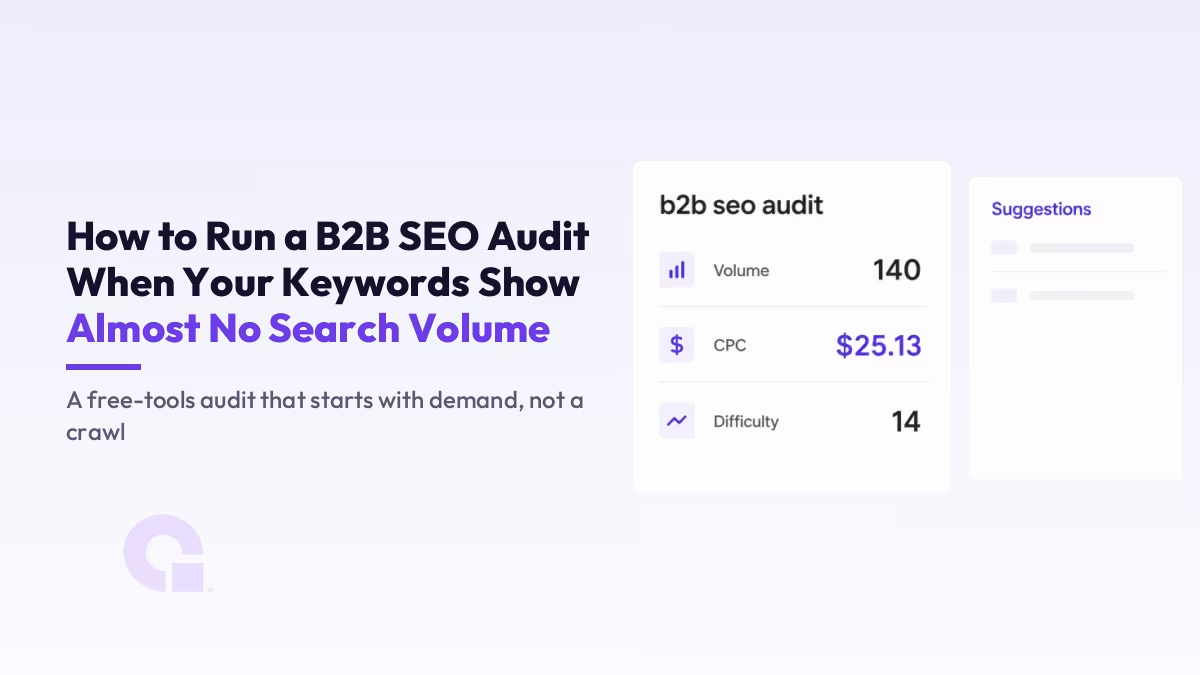
| b2b seo audit | 140 / mo | $25.13 | 14 | Too small to bother with |
| seo for b2b companies | 590 / mo | $52.04 | 33 | Worth it, but hard |
| b2b seo checklist | 10 / mo | $0 | 13 | Dead |
| b2b seo audit services | 70 / mo | $0 | 5 | Dead |
| b2b seo audit checklist | 0 | $0 | 4 | Does not exist |
Before you use any of those numbers, understand what they are. Tool volumes are modeled, rounded, and bucketed estimates, not Google’s own count, so treat them as one input and never as the verdict.
Now the five readings, in the order I take them.
- Read the cost per click. An estimated $25.13 a click on b2b seo audit means advertisers are paying roughly twenty-five dollars for one visit to a phrase with an estimated 140 monthly searches. Nobody pays that for an audience that does not buy, so the CPC is telling you about commercial intent that the volume figure completely hides.
- Check whether ads actually fire. This one is free and takes ten seconds: search the phrase signed out and look at the top of the page. If a block of paid results sits above everything else, real companies are spending real money to reach that searcher today.
- Check whether competitors target a phrase the tool scores at zero. b2b seo audit checklist reads an estimated 0 volume with a difficulty of 4, and yet a full page of agencies is writing content aimed at it. A zero that nine competitors are actively serving is not a zero, it is a gap in the tool.
- Read your own Search Console impressions. This is the only demand source no tool and no competitor can see. Filter Search Console to queries containing your category term over the last 28 days, and note that impressions with no clicks is a finding too, not a blank; here is what an impressions spike with no clicks usually means.
- Look at the size of the suggestion list, not just the seed. When I asked the tool for every related keyword around b2b seo audit, it returned the seed plus exactly two rows. A live commercial term with nine competitors on page one and a twenty-five dollar click, and the expansion is three rows deep. That emptiness is itself the signal that you are in a market too small for the tool to model well, and not a market that is too small.
Reading two is the one people skip, so here is what it looked like on the sibling phrase seo for b2b companies, an estimated 590 searches a month at an estimated $52.04 a click.
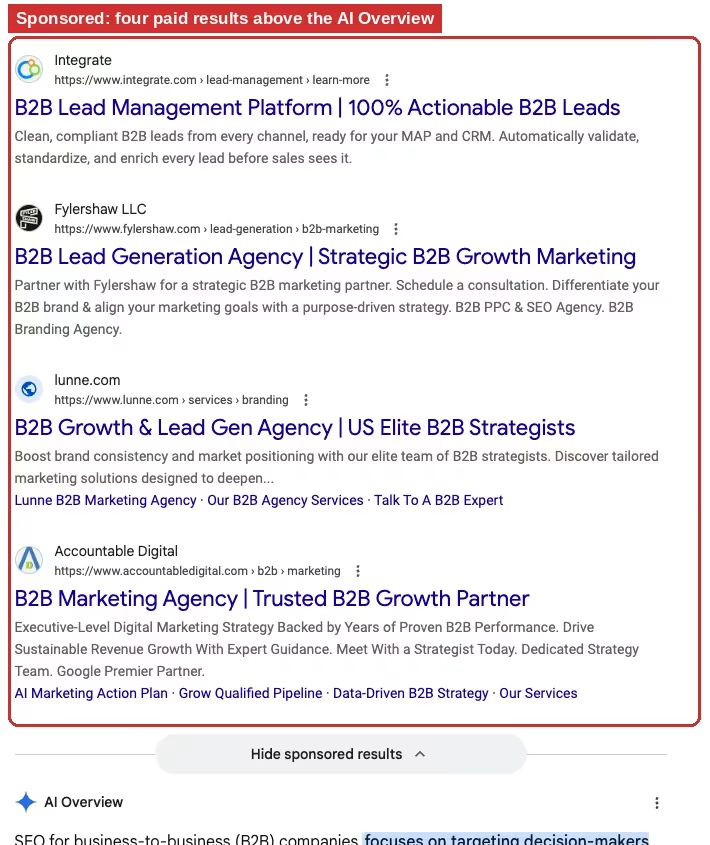
Four advertisers, above the AI Overview, on a query a volume-only reading would call mid-sized. That is a market telling you something the spreadsheet will not.
One honest caution before you act on any of this. A single search on a single day in one country is a worked example, never a rate, so run these readings on your own terms rather than borrowing my conclusions about mine.
Step 2: Check technical health, indexing, and AI crawler access
The technical pass confirms that the pages you decided to care about in step 1 can be crawled, rendered, and indexed without blocks. Run it against those pages first, not against your whole site, or you will spend a week fixing crawl errors on templates nobody searches for.
Work through these, and note that each one has a passing answer you can actually check.
- Indexing on your money pages. Run the URL Inspection tool in Search Console on each priority page. A pass reads “URL is on Google” with no coverage warning; anything else is a blocker, not a nice-to-have.
- robots.txt and canonical tags. Confirm nothing important is disallowed and that each priority page carries a self-referencing canonical. A canonical pointing somewhere else is how a page quietly stops competing for its own term.
- XML sitemap coverage. Every priority URL should appear in the sitemap and the sitemap should be submitted. Compare the submitted count against the indexed count in Search Console; a wide gap is your next investigation.
- Redirect chains and 404s. Chains leak link equity and slow crawling, and a redirect hop that lands on a 404 wastes the link entirely. Fix chains by pointing the first URL straight at the final destination.
- Core Web Vitals on product and pricing pages. Check LCP, INP, and CLS in the Core Web Vitals report, and prioritize the pages that convert rather than the blog. A slow blog post costs you a reader; a slow pricing page costs you a deal.
- Schema markup. Validate Organization markup at minimum, plus Product or Service where it applies. This is also what feeds the entity understanding that matters in step 5.
- AI crawler access. Check robots.txt for GPTBot, ClaudeBot, PerplexityBot, and Google-Extended alongside Googlebot. Several B2B teams block these, sometimes through a firewall rule nobody documented, and then wonder why they are invisible in AI answers. Google publishes its full crawler list if you need the exact user-agent strings.
Blocking AI crawlers is a legitimate business decision. Blocking them by accident and then paying an agency to improve your AI visibility is not, and I see the second one more often.
Step 3: Map your content to the B2B buying journey
List every priority term from step 1, tag each one as top, middle, or bottom of funnel, then mark which ones you have a real page for. The gaps in that grid are your content plan, and in B2B the gap is almost always in the middle.
The pattern I keep running into is heavy investment at both ends. There are educational guides bringing in traffic and a pricing page waiting at the bottom, with nothing in between that moves somebody from “we have this problem” to “you might be the vendor”.
While you are in there, check the on-page basics on each priority page: one clear H1, a title tag that carries the commercial term, a meta description that reads like a reason to click, and no two pages competing for the same phrase. Thin or duplicated pages get merged rather than kept.
Then check the internal links, because this is where most B2B sites leak. High-traffic blog posts should link down to the pages that convert, with anchor text that names the destination, and a topical map makes those clusters obvious. If you want to run this part properly, our internal linking audit walkthrough covers the mechanics.
Step 4: Check off-page authority and referring domains
Look at how many distinct domains link to you, whether any of them are the industry publications and directories your buyers actually read, and whether your brand is described the same way across them. Volume of links matters less here than whether the right handful exist at all.
The B2B specific check is consistency. If your homepage, your G2 listing, and your LinkedIn page each describe your product as a different category, you are asking every search and answer engine to guess which one is true.
Pull the descriptions from your main third-party profiles into one document and read them side by side. It is a boring exercise and it finds real problems in about half the sites I look at.
Step 5: Check whether AI answer engines cite your brand
Ask whether your brand appears when someone puts your category question to an AI answer, and treat that as a separate outcome from your Google ranking. You can rank on page one and be absent from the summary sitting above it.
I want to be clear that this is not my discovery, and I would rather show you why than claim it. Google itself now lists the check inside its own AI Overview for this exact query.
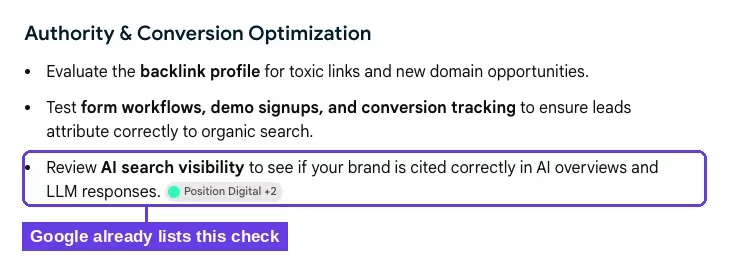
Read verbatim, Google’s step is “Review AI search visibility to see if your brand is cited correctly in AI overviews and LLM responses.” Tyler Hakes made the same point on his framework page back in June 2026, writing that “ranking and being cited in the AI Overview are now two separate outcomes and belong on the same scorecard.”
So this step is now the baseline rather than an edge. Leaving it out of your audit in 2026 is what makes the audit look dated.
Doing it manually is fine and costs nothing. Write down six questions a buyer would ask about your category, run each one signed out through the assistants your buyers use, and record whether you are mentioned, whether you are recommended, and whether the description of you is accurate.
Keep your expectations calibrated, though. We ran a controlled test on whether this kind of work reliably moves citations, and the honest answer was messier than the vendor pitch, which I wrote up in does generative engine optimization work. If you want the mechanics of getting pulled into an answer, optimizing for Google AI Overviews covers what we have actually seen work.
One practical note from our own testing: an AI Overview is collapsed by default, so expand it before you read the sources, or you will record a shorter citation list than the one that is really there.
Step 6: Compare yourself against competitors on your own terms
Take your five to ten priority phrases, search each one signed out, and write down who ranks and what type of page it is. You are looking for the shape of the page Google is rewarding, not just the names.
That distinction decides what you build. On b2b seo audit, six of the nine organic results are articles and three are agency service pages, so a genuinely useful resource can win the informational half while the service pages fight over the commercial half.
If the whole page is service pages, a blog post will not get you there and you need a service page of your own. Getting that call wrong is how good content ends up on page four.
What tools do you need to run a B2B SEO audit?
You can complete every step above with free tools plus one keyword lookup. The paid stack makes the work faster at scale, but nothing in this audit is gated behind it.
| Job | The usual paid pick | What I would use to start |
|---|---|---|
| Indexing, impressions, query data | Nothing paid needed | Google Search Console |
| Traffic and conversion paths | Nothing paid needed | Google Analytics 4 |
| Speed and Core Web Vitals | Nothing paid needed | PageSpeed Insights, plus the Search Console report |
| Site crawl | Screaming Frog SEO Spider | Screaming Frog’s free tier, which crawls up to 500 URLs |
| Keyword volume, CPC, difficulty | Ahrefs or Semrush | Any keyword tool with a free daily allowance, read as an estimate |
| Backlinks and referring domains | Ahrefs or Semrush | The free backlink checkers, accepting an incomplete picture |
| AI answer visibility | A multi-engine tracking platform | Six questions, asked by hand, signed out, recorded in a sheet |
The free versions are genuinely limited and I am not pretending otherwise. A 500-URL crawl limit is real, and free backlink data is partial. For a site with a few hundred important pages, which describes most B2B companies, they are enough to find the problems worth fixing.
How do you turn a B2B SEO audit into a prioritized plan?
Sort every finding by how close it sits to revenue, then by how hard it is to fix, and work the top of that list. An audit that ends as a two hundred item spreadsheet is a document nobody will act on.
In practice that means the pages your buyers land on before they convert get fixed first, even when a bigger technical problem exists somewhere quieter. A blocked pricing page outranks a sitemap warning every time.
Give each item an owner and a date, because most audit findings die from being nobody’s job rather than from being wrong. Three fixed items beat thirty documented ones.
What should you measure after a B2B SEO audit?
Measure impressions and clicks on your priority terms, then follow those sessions through to demo requests, MQLs, and closed revenue. Rankings and traffic are early indicators, not the result.
The B2B lag makes this awkward and there is no way around it. A fix you ship in August may show up as pipeline in November, so agree the measurement window before you start rather than arguing about it later.
Keep a note of your AI answer results too. Re-run the same six questions monthly and log whether the mentions moved, because that surface changes faster than the rankings do.
So, where should a B2B SEO audit actually start?
With the keywords, and specifically with the honest question of whether the terms you have chosen carry buyers. The crawl is easier and it feels more productive, which is exactly why so many audits open there and never revisit the assumption underneath.
Search volume is a modeled estimate that was built for markets with lots of searchers, and B2B is not that. Treating it as the deciding number is how teams talk themselves out of terms their competitors are quietly paying twenty-five dollars a click for.
The rest of the audit is well covered elsewhere and the consensus on it is broadly right, so I have kept those steps tight and pointed you at the checks that pass or fail. Spend your extra hour on step 1, because it is the one that decides whether the other five were aimed at anything.
Common questions about B2B SEO audits
How long does a B2B SEO audit take?
The six steps above take a focused week for a site with a few hundred pages, with step 1 taking a day on its own. Larger multi-domain audits that add pipeline attribution and multi-engine AI testing commonly run four to six weeks.
How much should a B2B SEO audit cost?
Anywhere from nothing to five figures, and the spread is mostly about scope rather than quality. Optimist publishes its own CORE Analysis at $7,500, which is a fair marker for a full pipeline-grade audit; the version in this article costs your time.
Should you run a B2B SEO audit in-house or hire an agency?
In-house works well for the technical, content, and demand steps if somebody owns SEO properly. An outside audit is worth paying for when you need a third party to make the case to a CFO, which is a political problem rather than a technical one.
Work with WpConsults
Stuck on which B2B terms are actually worth it?
Send me the phrases your tool called dead and I will tell you which ones I would still go after, and why.
Update Logs
04 Aug 2026
- First published, with the demand figures and both search screenshots taken on 3 August 2026. The AI visibility section is the fastest-moving part here, so it carries its own date and will be re-checked quarterly.
Want our posts to show up more often on Google?
One step & Google will surface this site in your Top Stories.