Almost every guide on category page SEO tells you to write unique content for every category page, and most of them attach a word count to it. The only study I could find that measured what top-ranking category pages actually carry found an average of 310 words, and 29 of the 300 pages it looked at held nothing but a heading.
So here is what that study found, what Google’s own ecommerce documentation says about category page copy, and what I saw when I opened the category pages ranking for two real commercial terms on 11 August 2026.
Key Takeaways
- Category pages should carry some unique text, but the word counts the popular guides recommend have no published study behind them.
- James Brockbank of Digitaloft measured 300 category pages ranking first on Google UK, with the URLs collected on 13 August 2025, and found an average of 310 words of unique content, 66% of pages under 400 words and 44% under 200.
- In that same set, 29 of the 300 first-place pages, which he reports as 10%, had no content at all beyond an H1, and 18 of those 29 belonged to household-name brands.
- Google’s ecommerce site structure documentation, last updated 10 December 2025, treats a category page as a navigation node. It covers links, crawlability and structured data, and does not mention category page copy.
- Of the three category pages I could open on 11 August 2026, one carried intro copy above the product grid and two went from heading and filters straight into products.
- adidas, ranking first for “womens running shoes”, splits its copy: two lines above the grid behind a “Show more” toggle, then roughly 200 words and an FAQ below the products.
- The “150 to 300 words rank 2.7x higher” claim has no study, sample size, date or author behind it that I could find, so do not build a content budget on it.
- Copy earns its place when it is specific to your range and your store. If it could be pasted onto a competitor’s page unchanged, it is not doing much.
Where did the advice to write unique content on every category page come from?
The advice came from a real problem. A category page that is nothing but a grid of product tiles gives a search engine very little of its own to read, and thin listing pages have been a live worry in ecommerce SEO for well over a decade.
What got added later was the number. Most of the popular guides now name a range, commonly 150 to 300 or 200 to 400 words, and I cannot find a published measurement sitting behind any of it.
You will also run into a precise-sounding multiplier: that category pages with 150 to 300 words of unique content rank 2.7 times higher than pages with only a product grid. I went looking for the study behind that figure and found no sample size, no collection date and no named author.
A number that specific with nothing underneath it is worth ignoring, and I would rather tell you I could not source it than repeat it.
I searched ecommerce category page seo signed out on 11 August 2026 and read the top ten. Every one of them is a prescriptive best-practice guide, and the publish dates are the first thing worth noticing.
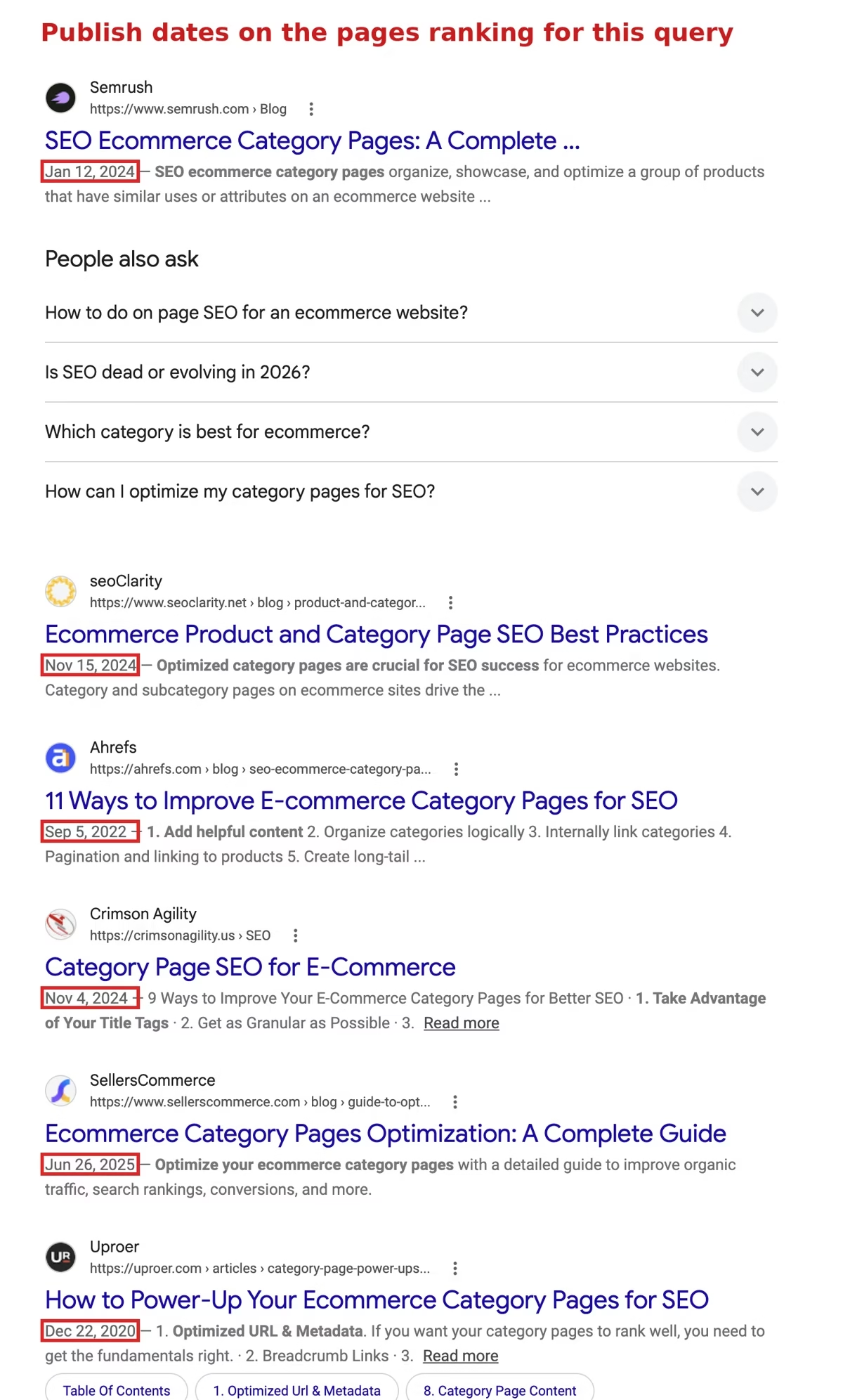
Two of those pages were published in December 2020 and September 2022 and they are still holding top-ten positions, on a page type that has changed shape since. The rest are from 2024 and 2025.
Google’s AI Overview on the sibling query category page seo repeats the same advice back. Its wording, verbatim from my capture that day: “Avoid Thin Content: Do not leave the page as a basic price list; add value with helpful text, buying tips, or FAQs.”
I am not saying those guides are wrong, because nobody has shown that either. On the word count question they have nothing published behind them, so they repeated what was already in circulation.
What did Digitaloft’s study of 300 top-ranking category pages find?
Digitaloft published the only measurement of this I could find, and the headline number is 310 words. James Brockbank James BrockbankManaging Director and Founder, DigitaloftSEO and digital PR practitioner who published a 2025 study measuring the unique content on 300 eCommerce category pages ranking first on Google UK.DigitaloftX, Managing Director and Founder of Digitaloft, collected the category URLs ranking first on Google UK for 300 commercial-intent terms on 13 August 2025 and counted the unique text on each page.
| What Digitaloft counted across 300 UK first-place category pages | The finding |
|---|---|
| Average unique content on the page | 310 words |
| Pages carrying under 400 words | 66% |
| Pages carrying under 200 words | 44% |
| Pages carrying nothing but an H1 | 29 of the 300, which the study reports as 10%. 18 of those 29 were household-name brands |
| Pages carrying more than 600 words | 13% |
| Pages carrying more than 1,000 words | 6% |
The method decides what the 310 covers, so it is worth reading before you use the number. In Brockbank’s own words in the published study:
“Page content, in this case, was taken to mean any content unique to the page that is not part of the product grid (e.g., product titles or prices), buttons, or faceted navigation. The page content includes text above and below the product grids, as well as any FAQ sections. H1 headings were excluded because they are typically present by default.”
He is also unusually straight about what the study does not do, and that matters more than the average: “The aim wasn’t to prove that word count directly affects rankings, but to see what top-ranking pages are actually doing in practice.”
So 310 words is a description of what those pages happened to carry, not a target to write to. He says as much himself: “It’s not about hitting an arbitrary word count.”
Two limits travel with these figures. The study reads Google UK and the URLs were collected in August 2025, and it looks at position one only rather than the whole top ten.
One honest note on who published it. Digitaloft is a content agency, and this is a content agency telling clients they need less content, which cuts against its own obvious commercial interest.
What does Google’s documentation say about category page content?
Nothing. I read Google’s ecommerce site structure page and the ecommerce documentation hub end to end on 11 August 2026, and neither one tells you to write a description for your category pages. Both were last updated on 10 December 2025.
The site structure page treats a category page as a navigation node: links, crawlability, structured data, and where the page sits in the hierarchy. The only passage on it that mentions category pages is about linking.
“If category pages don’t include direct links to all products in a category, Googlebot might not find all of your products by crawling alone. These products may be reachable from a search box, but not via category browsing. Googlebot generally doesn’t try to submit searches into a search box as part of crawling a site. It’s strongly recommended to link to all products that you wish indexed.”
The words “description”, “copy” and “word count” do not appear on that page. The ecommerce guide set runs to eight pages, covering URL structure, structured data, product data, pagination, reviews and site structure, and not one of them is about category page content.
Now the limit on that, because an absence is easy to overreach. Google is silent here, which is not the same as Google saying you do not need text. Silence means the advice has no documented backing, and that is all it means.
The nearest thing to a content instruction anywhere in that guide set is the general line the site structure page closes on: “The ultimate ecommerce SEO best practice is to create useful and interesting content that is valuable to users.”
What did I find on the category pages ranking for two commercial terms?
Of the three category pages I could open on 11 August 2026, one carried intro copy above the product grid and two went from heading and filters straight into products. I ran a signed-out search for two head commercial terms, “womens running shoes” and “office chairs”, then opened the retailer pages ranking on them and read the full-page captures by eye.
Nine pages went into that attempt. Four refused the request outright, two turned out to be homepages rather than category pages, and I come back to those below, which left three real category pages to read.
| Category page | Query and organic position | Above the product grid | Below the product grid |
|---|---|---|---|
| adidas.com women’s running shoes | “womens running shoes”, #1 | H1, then two visible lines of intro truncated behind a “Show more” toggle, then sub-category tabs and a “167 results” count | An H2, then two paragraphs of roughly 200 words together, then an FAQ block with three questions |
| roadrunnersports.com women’s running shoes | “womens running shoes”, #8 | H1 reading “WOMEN’S RUNNING SHOES (268 ITEMS)”, then filter chips and the grid. Not one sentence. | Not cleanly captured, so no claim made |
| store.hermanmiller.com office chairs | “office chairs”, #2 | Breadcrumb and H1 “Office Chairs”, then straight into imagery and product cards. No paragraph. | Not cleanly captured, so no claim made |
The adidas page is the useful one, because it answers the question store owners actually ask, which is where the copy goes without burying the products.
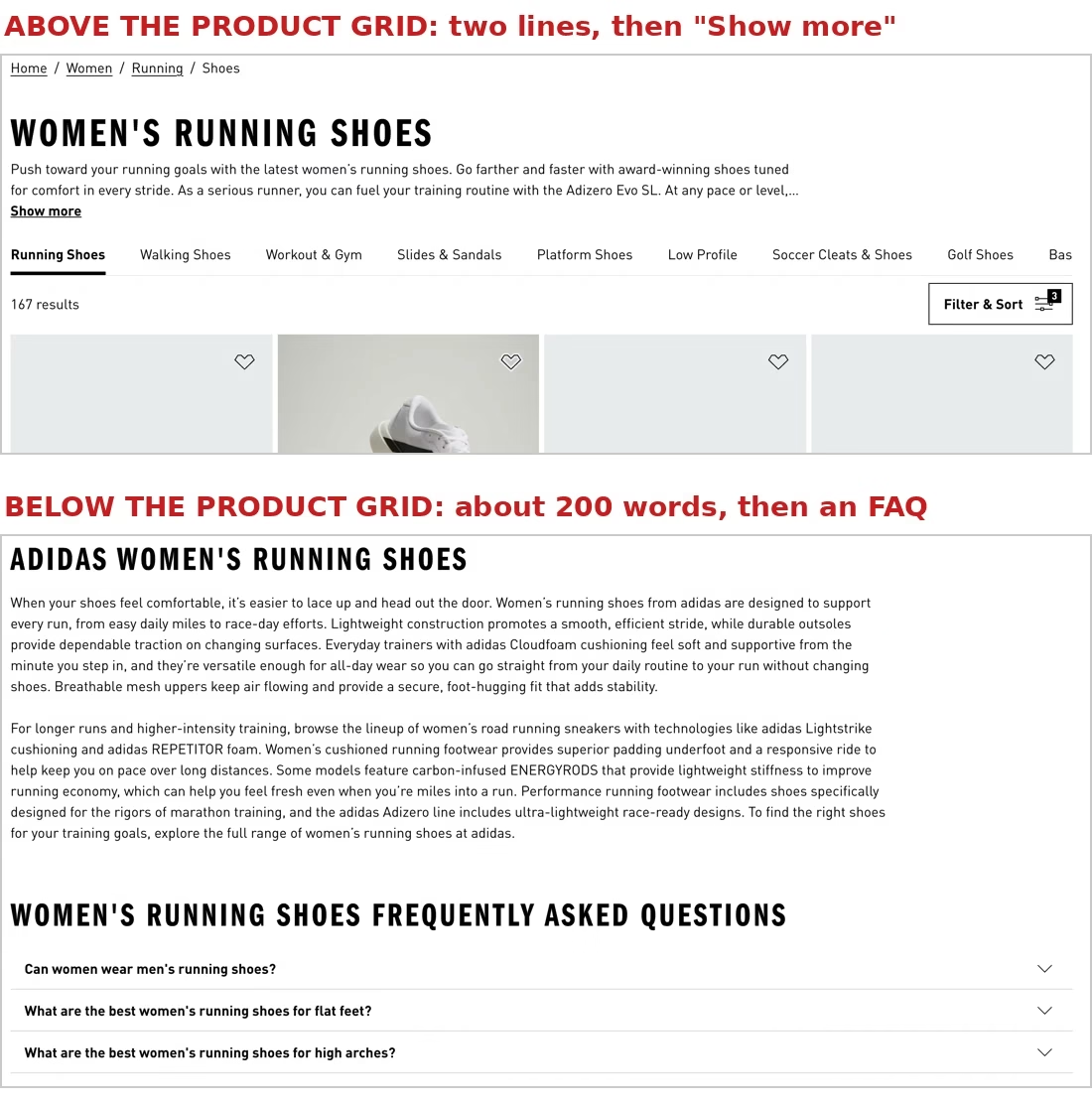
Now the limits on what I just showed you, stated plainly rather than buried at the bottom:
- No percentage comes out of three pages. One of the three carried copy above the grid, and that is a sentence about those three pages, never a rate for US retail.
- Four of the nine pages refused the request. Dick’s Sporting Goods returned “Our website is currently unavailable in your area”, Nike served a country picker instead of the category, Costco returned “Access Denied” from Akamai, and Jerome’s rendered with no grid at all.
- So this is a read of the pages that will serve a request from Bangladesh, where I am. That matters to you too: if you audit US retailer category pages from outside the US, expect the same wall on a chunk of them.
- Two of the full-page captures came back with a stitching artifact, where the header re-rendered partway down the frame. That is why the table makes no claim about what sits below the Road Runner Sports and Herman Miller grids.
The two homepages are the other half of that nine, and they were a surprise. Two of the top six results for “office chairs” were homepages rather than category pages, and what sits below the fold on both is not category description at all.
It is operational buyer answers: shipping cost, whether the item is in stock, whether they ship to Alaska and Hawaii, tax exemption for resellers, and payment terms. That is a different kind of content doing a different job, and it is worth a look if your own copy is a paragraph explaining what an office chair is.
Where should category page copy go so it does not push your products down?
Keep the part above the product grid to a couple of lines, collapse the rest behind a toggle if you need more, and put the longer block and any FAQ underneath the products. That is what adidas does on the page ranking first for “womens running shoes”, and it costs almost no vertical space before a shopper sees a product.
The guides on page one tend to answer this question with both options at once, and Google’s AI Overview does the same thing.
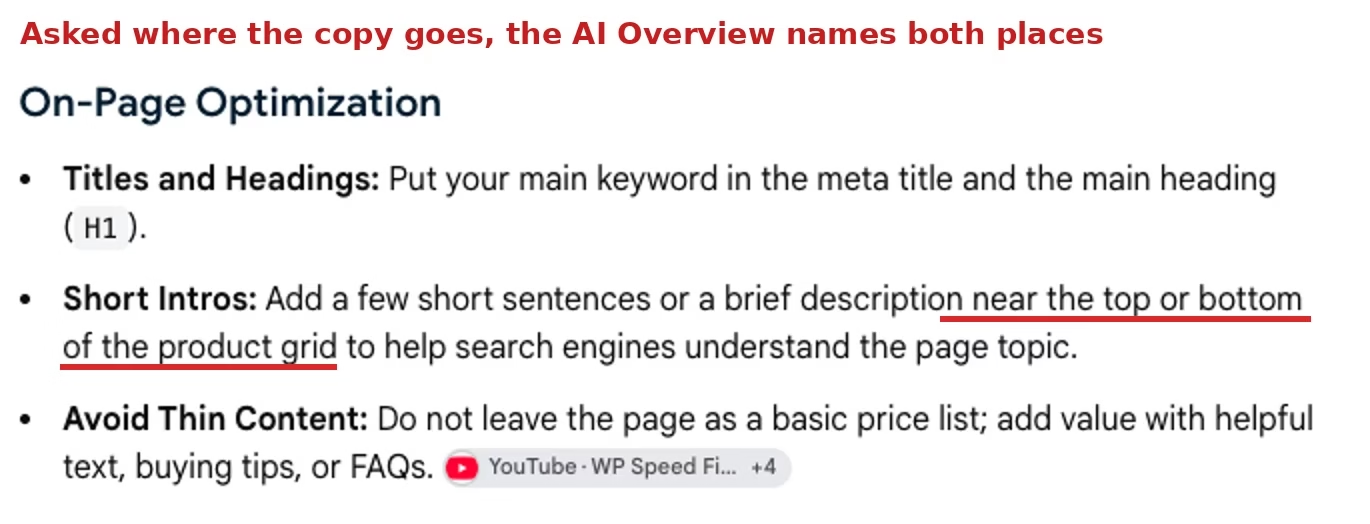
Its wording is “Add a few short sentences or a brief description near the top or bottom of the product grid”, which lists the places an answer could sit without choosing one.
Brockbank does choose, and his version matches the adidas layout: “Buying guides don’t belong on category pages. Long, blog-like guides beneath the product grid often dilute commercial intent. Instead, use a concise intro above the grid and targeted FAQs below.”
That is his opinion rather than something his numbers measured, so take it as a practitioner’s read. It matches the one page I was able to read above and below the grid, which is worth something without being proof.
How do you decide which categories on your store actually need copy?
Work through the categories you are trying to rank rather than your whole category list. Most stores have a handful of categories carrying a term with real commercial demand, plus a long tail that exists so people can browse, and those two groups need very different amounts of time from you.
Here is the order I would run a category copy audit in:
- Name the term each category is supposed to win. If you cannot name one, that category does not need copy, it needs to be easy to find and browse, and you can stop there.
- Search that term signed out and open the pages that rank. Look at what they put above the grid and what they put below it, because that shows you what the result set for your term currently looks like, which beats a generic best practice.
- Write for the choice a shopper is making. Nobody landing on your “office chairs” page needs to be told what an office chair is. They need to know what is in your range, what separates the options, and why they would buy it from you.
- Run the swap test on anything you already have. Brockbank’s version is the sharpest I have seen: “If your category page content could be lifted pretty much word-for-word and placed on your competitors’ site, it’s too generic.” Text like that is not earning its space.
- Check that a category page is the page you want ranking. A category page and a product page competing for the same term is a cannibalization problem, and copy will not solve it, so start with my guide to running a keyword cannibalization audit.
- Leave the rest alone. Writing sixty paragraphs to satisfy a rule is a week of work spent on a word count nobody has measured.
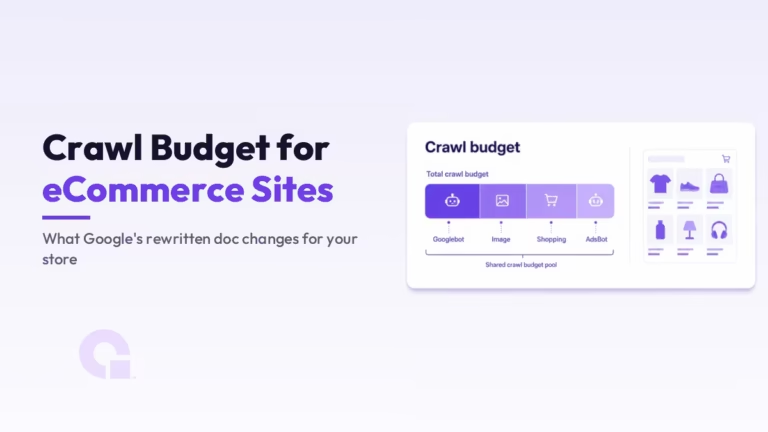
One caution on where this can drift. If your real category problem is tag, filter and pagination URLs multiplying on their own, copy will not touch it, and I have covered that for Shopify collections. The crawl side of the same story sits in crawl budget for ecommerce sites.
And if the text worrying you is on your product pages rather than your categories, that is a different mechanism with a different answer, which I went through in duplicate supplier descriptions.
So do you need to write a description for every category page?
No, and I would not spend a week writing them. The evidence we have says most top-ranking category pages carry a short block rather than an essay, 29 of 300 carried nothing at all, and Google’s ecommerce documentation does not ask for category page copy on either page I read.
That is not permission to strip every category back to a heading either. Most of the pages getting away with nothing were household names with brand searches behind them, 18 of those 29, and if that is not you, a short specific block gives Google something of yours to read and gives a shopper a reason to buy here instead of in the next tab.
If this were my store, I would take the five or six categories that carry real commercial terms, write two lines above the grid and a genuinely useful FAQ below it, and leave the rest alone until something tells me otherwise.
Common questions about category page content
How many words should an ecommerce category page have?
There is no supported target. The only published measurement, Digitaloft’s 300 UK pages ranking first in August 2025, averaged 310 words, and its author states plainly that he was not testing whether word count affects rankings. Treat 310 as a description of what those pages happened to carry.
Can I reuse the same description across similar categories?
You can, but it fails the swap test that makes category page copy worth having: if the text would sit just as comfortably on a competitor’s page, it is generic. The same applies when it would sit just as comfortably on your own next category. Write to the range on that specific page instead.
Work with WpConsults
Not sure which of your categories are worth the writing?
Send me your category list and the terms you are chasing, and I will tell you which ones need copy and which ones are fine as they are.
Update Logs
11 Aug 2026
- Published. Built on Digitaloft’s 2025 study of 300 top-ranking UK category pages, a read of Google’s ecommerce documentation as it stood on 10 December 2025, and first-hand captures of three ranking retailer category pages taken the same day.
Want our posts to show up more often on Google?
One step & Google will surface this site in your Top Stories.