Google patented a system that fakes ranking changes to catch manipulative SEOs. Here is how the Rank-Modifying Spammers patent works, and how not to fall for it.
Key Takeaways
- Google’s “Rank-Modifying Spammers” patent (US8682892B1) describes deliberately altering a suspected site’s rankings to see how the owner reacts.
- It is behavioral, not just algorithmic: your reaction to a ranking move is the signal it is built to capture.
- The patent describes three plays: rankings that do not move, a deliberate drop, and wild fluctuation for up to about 70 days.
- The tell is panic; building more links, swapping anchor text, or a reactive disavow after a drop are exactly what confirm manipulation.
- The counter is patience: build links because the content earns them, then leave the rank tracker alone through the transition window.
- One honest caveat: a patent is what Google could do, not proof of what runs in the live algorithm today; treat it as a behavioral lesson, not a confirmed mechanism.
Most SEOs obsess over rankings. They build links, tweak on-page elements, and then refresh their rank tracker every morning, ready to react the moment something moves.
That reactive instinct is exactly what Google has patented a system to exploit.
The Google Rank-Modifying Spammers patent is one of the most psychologically interesting and least discussed mechanisms in search. The idea it describes does not just passively detect manipulation; it actively induces a response, watching how you react to bait ranking changes to judge whether a site is being artificially manipulated.
If you do any kind of link building, on-page work, or active SEO, it is worth understanding this patent. Not because it should change what you do, but because it should change when and how you react.
What is the Google Rank-Modifying Spammers patent?
The patent, formally titled “Rank-Modifying Spammers,” was filed by Google and describes a method for detecting sites whose rankings are being artificially manipulated. But rather than simply penalising sites after detection, the system it describes uses a “rank transition function” to deliberately produce unexpected ranking outcomes when manipulation is suspected.
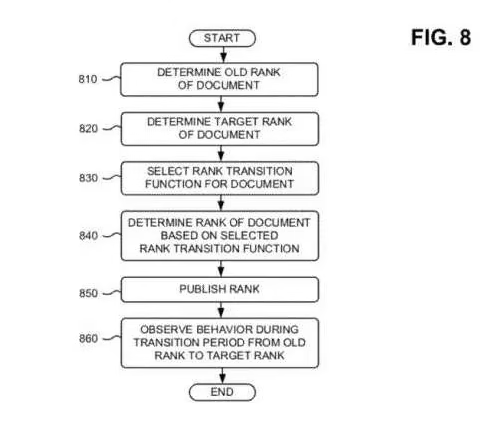
In plain English: Google can change your rankings on purpose to see how you react.
So the system may shift your site’s rankings, in what looks like a random way, before it settles on a target rank.
The official filing can be read at Google Patents. It was first surfaced in the SEO community by researchers analyzing Google’s filings, but it remains largely unknown among practitioners.
One honest caveat before we go further: a patent shows what Google designed and could deploy, not proof of exactly what runs in the live algorithm today. Google files thousands of patents it never fully ships. So treat this as a window into how Google thinks about behavior, and a strong reason not to panic, rather than a confirmed mechanism you can watch operating.
The three scenarios: how Google tests you
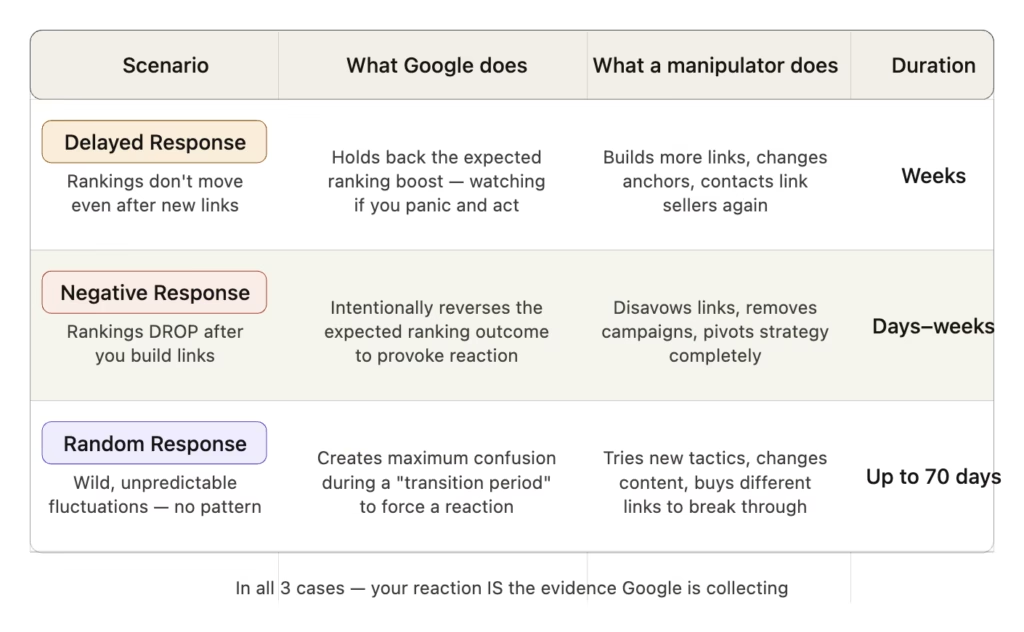
The patent outlines three manipulations the system can apply to a suspected site’s rankings. Each one is a test, and each one is bait.
1. The delayed response (rankings do not move)
You build links. Your signals improve. Your rankings do not move at all for weeks.
This is not necessarily a sign that your links are not working. According to the patent, the system may be applying a delay to your expected ranking change to observe your behavior. Will you panic? Will you build more links? Will you start tweaking the page?
What an innocent site owner does: nothing unusual. They keep publishing, maintaining the site, and trusting the process.
What a manipulator does: they panic. They build more links, change anchor text ratios, and go back to their link suppliers, and in doing so they confirm exactly what Google suspected.
2. The negative response (a ranking drop)
You build what you believe are high-quality links. Your rankings drop.
Before you spiral into a link audit, consider this: the patent explicitly describes a scenario where the system intentionally reverses the expected outcome of a ranking signal change. The drop need not mean your links were toxic; it can be a deliberate inversion designed to provoke a reaction.
This is one of the most counterintuitive ideas in the patent. Many SEOs, seeing a drop after a link campaign, will:
- start a disavow campaign,
- remove the links they built,
- or pivot to a completely new strategy.
Each of those actions tells Google something. Specifically, it suggests you were closely watching the relationship between your link building and your rankings, behavior consistent with active manipulation.
3. The random response (wild fluctuation)
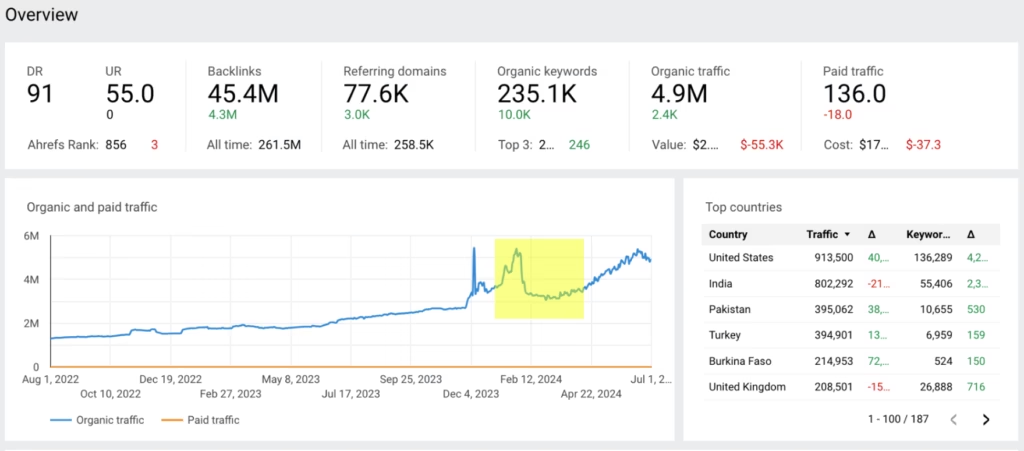
Your rankings fluctuate wildly and unpredictably, with no discernible pattern, for up to 70 days in the patent’s language.
This is the “transition period” described in the document. It is meant to be long enough that a manipulator feels compelled to act: to try something different, to stop what they are doing, or to do more of it to break through the noise.
The random response is arguably the most effective of the three, because it creates the highest psychological pressure to react.
The core mechanism: your reaction is the evidence
Here is the idea from the patent that should reframe how you think about SEO entirely:
Google “observes spammers’ reactions to rank changes caused by the rank transition function to identify documents that are actively being manipulated.“
Your reaction is the data point. Not your links, not your anchor text distribution, not your on-page changes; your behavioral response to ranking fluctuations is what the system is built to capture.
An innocent site owner, one who has never engaged in manipulation, has no reason to react urgently to a temporary drop. They did nothing to cause it, so they have no reason to think they can fix it. They carry on.
A manipulator, on the other hand, knows they were doing something. They have been watching closely, and when rankings move unexpectedly they respond with urgency. That urgency is the tell.
Why this matters for link building now
Let me be direct: link building works. It remains one of the most reliable levers in organic SEO, it is how link juice flows to your pages, and this patent changes nothing about that. What it does change is how you should operate after building links.

Here is what the patent suggests about best practice:
- Build links, then step back. Do not check rankings daily for the first 8 weeks; give the transition period time to resolve.
- Separate link building from rank tracking. Do not build a mental model that correlates each individual link to a specific ranking change in real time.
- Never disavow reactively. Unless links are overtly spammy and you have a manual action, a reactive disavow based on a short-term drop can do far more harm than the links themselves, and it signals exactly the behavior the patent is built to detect.
- Think like a publisher, not a manipulator. A publisher builds links because the content deserves to rank; they do not watch rankings the way a trader watches stock prices.
The broader point: Google’s behavioral layer
This patent hints at something deeper about how Google approaches spam. It is not purely algorithmic in the traditional sense; it is behavioral. The system models your response patterns over time, which puts constantly reactive SEOs, the ones who change strategy every time rankings shift, at a structural disadvantage to those who operate with patience and consistency.
It is also why so much “SEO advice” online is counterproductive. Forums full of people sharing ranking-drop stories after link building, swapping tactics in real time, and recommending immediate disavows are the collective output of an industry trained to panic, reacting to exactly the kind of noise this patent describes.
Related reading and resources
- Google’s Rank-Modifying Spammers patent (US8682892B1), the official filing.
- Google’s guidelines on link spam, Google Search Central.
- Google’s How Search Works, ranking systems.
- Bill Slawski’s analysis of Google patents, one of the most thorough patent resources in SEO (archived).
So how should you actually react to a ranking drop?
Google has, at least on paper, designed a system to nudge SEOs into revealing their tactics, and for much of the industry the panic reflex plays right into it. The counter-strategy is almost boringly simple: do not take the bait.
Build links because your content deserves them, make on-page improvements because they serve users, then let the process run without watching, reacting, or second-guessing every wobble in the first 70 days. In the context of this patent, patience is the most strategically sophisticated thing you can do.
Update Logs
05 Jul 2026
- Removed a hosting banner that did not belong on this topic.
27 Jun 2026
- Refreshed for 2026 with a Key Takeaways summary and an important caveat that the patent shows intent, not a confirmed live mechanism.
- Tightened the wording and made the link-building guidance evergreen.
Want our posts to show up more often on Google?
One step & Google will surface this site in your Top Stories.