A topical map is a plan for covering a subject so thoroughly that search engines read your site as an authority on it, not just a page that happens to mention a keyword. Instead of chasing single terms, you map the whole topic, a central pillar with supporting clusters around it, and link them so the depth is obvious.
This guide walks through what a topical map is, how it differs from keyword research, how to build one step by step, and where it matters most, with my honest take on when to make it your priority.
Key Takeaways
- A topical map organizes content around a subject (pillar plus clusters), so your site shows depth on a topic rather than scattered keyword hits.
- It builds on keyword research rather than replacing it; keywords feed the map, the map gives them structure and reduces cannibalisation.
- Internal links are what make the map work; they connect clusters to the pillar and signal coverage to search engines and readers alike.
- For a new site with little authority, a tight topical map is often the fastest credible route to ranking, because depth on a focused subject is something you control.
What a topical map actually is
Think of a topical map as a roadmap for your site’s content. It is a deliberate plan that organizes everything around key topics and subtopics, so a visitor (and a crawler) can see you cover the subject fully, not in scattered fragments.
The shift it represents is moving from “which keyword does this page target” to “how completely do we cover this subject.” That difference is the whole point: a single optimized page can rank for a term, but a well-mapped topic earns authority across a whole cluster of related searches.
Why topical maps matter for SEO
Search engines reward context. When your content is organized around a topic and interlinked, you make it easy for Google to understand what your site is genuinely about, which supports stronger rankings across the whole area rather than one lucky page.
It also helps readers, and that feeds back into SEO. A logical structure means visitors find the next thing they need without bouncing, you naturally cover a wide spread of long-tail queries, and by covering subtopics in depth you position yourself as a real authority in the niche. Those three effects, comprehension, coverage, and authority, are why the approach works.
Topical maps vs keyword research
Keyword research is not dead; it feeds the map. The difference is what you do with the keywords once you have them, and the table below sums it up.
| Keyword research | Topical maps |
|---|---|
| Focuses on individual terms | Focuses on broader topics and subtopics |
| Can lead to disconnected content | Creates a cohesive content structure |
| May miss contextual relationships | Emphasizes semantic relationships |
| Can cause keyword cannibalisation | Reduces internal competition |
The core elements of a topical map
A solid map rests on four parts working together: pillar content, the broad page that gives the comprehensive overview of the main topic; cluster content, the supporting pieces that go deep on specific subtopics; internal links, the connective tissue that ties clusters to the pillar and to each other; and semantic relevance, making sure each piece covers the related concepts and terms a reader (and Google) expects on that subtopic. Miss the linking and you just have a pile of posts; miss the semantic depth and the cluster reads thin.
How semantic SEO fits in
Semantic SEO is about understanding the intent and context behind a search, and it pairs naturally with topical mapping. It helps you spot the related subtopics worth covering, use natural language and synonyms instead of repeating one phrase, and answer the actual questions behind a query rather than just matching words.
Folding those principles into your map is what makes the content not just keyword-rich but genuinely relevant, and it is worth seeing the idea applied; the semantic SEO examples piece shows how it plays out in practice.
How to build a topical map, step by step
Step 1: Understand your niche and audience
Before mapping anything, know the terrain. Get clear on your audience’s real pain points and the questions they actually ask, using analytics, search data, and direct customer feedback. The map is only as good as your understanding of what readers need, so this step is not optional.
Step 2: Research the topic broadly
Now expand the subject into all its parts. Tools like Ahrefs Content Explorer and Semrush Topic Research surface popular subtopics, related questions, and the terms people use, which gives you the raw material the map is built from.
Step 3: Group topics into clusters
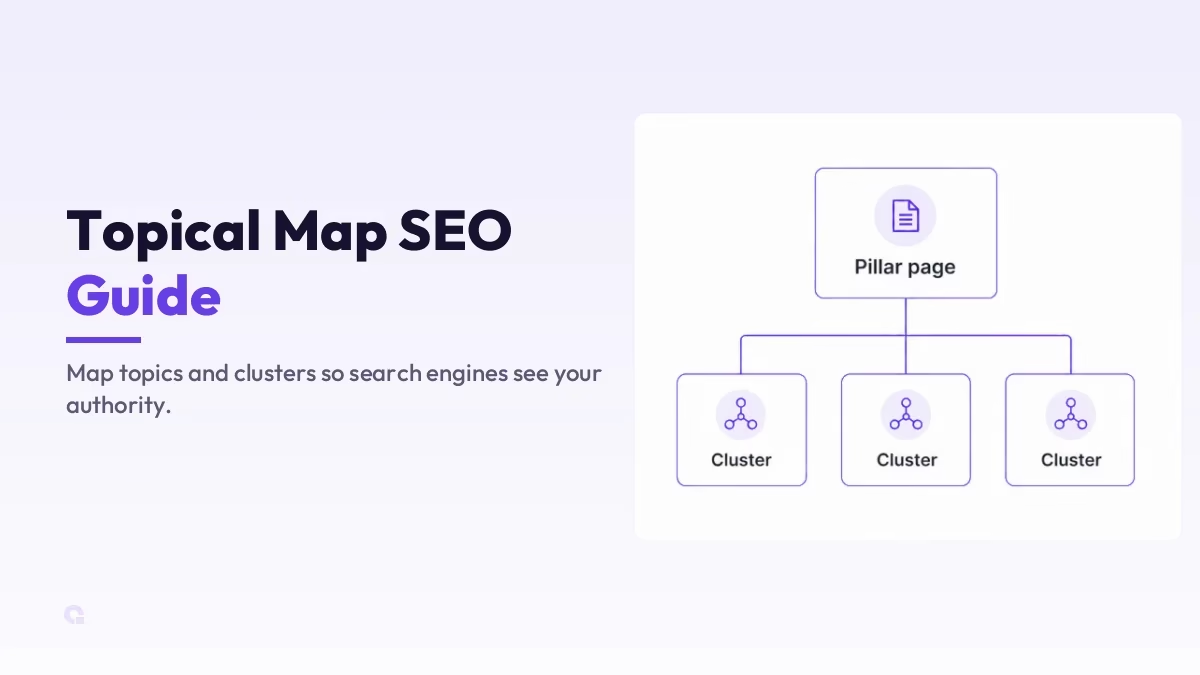
With your research in hand, group related topics into a hierarchy: broad topics at the top, specific subtopics branching below. This is where the map takes shape. The structure below shows the basic pillar-and-cluster shape every map follows.
To make it concrete, here is how a fitness site might break its main topic into subtopics:
| Category | Subcategories |
|---|---|
| Fitness (main topic) | Strength Training, Cardio, Nutrition |
| Strength Training | Weightlifting, Bodyweight Exercises |
| Cardio | Running, Cycling |
| Nutrition | Meal Planning, Supplements |
Step 4: Match each piece to search intent
For every topic and subtopic, ask what the searcher actually wants, because the same subject carries different intents. “How to start weightlifting” is informational, “best running shoes for beginners” is transactional, and “gym near me” is navigational; mapping content to the right intent is what turns coverage into traffic that converts.
Step 5: Create the pillar pages and cluster content
Now write. Start with the pillar pages, the comprehensive guides covering each main topic, then build the supporting cluster posts that go deep on the specifics and point back to the pillar. The pillar gives the overview; the clusters earn the long-tail rankings.
Step 6: Interlink, then monitor and update
Internal linking is the part that brings the map to life: link clusters to their pillar and to each other so readers and crawlers can move through the topic. After that, treat the map as living, review your analytics and rankings, and keep adding or refreshing clusters as the subject evolves, because a topical map is never quite finished.
Topical maps for different types of sites
The shape adapts to the site. A content or blog site centers on broad pillar guides that act as hubs for deeper articles. An eCommerce site usually maps around product categories and buyer’s guides, for example Home Appliances branching into Kitchen and Laundry, then Refrigerators and Dishwashers, then specific types under each, so category and educational pages reinforce one another. A news or media site builds maps around ongoing stories or evergreen themes, using tags and categories to connect related coverage.
Tools that help you build a topical map
You can map by hand, but a few tools speed up the research and organization:
- Ahrefs Content Explorer for discovering topics and gauging their potential.
- Semrush Topic Research for in-depth topic analysis and content ideas.
- Surfer SEO for optimizing each piece toward semantic relevance.
- MarketMuse for advanced topic modeling and content planning.
- SEOWriting.ai for generating draft topical maps and content quickly with AI.
None of these build the map for you in a way you can publish blindly; they accelerate the research and drafting, and your judgment on intent and structure still does the real work.
Common mistakes to avoid
The usual failures are predictable. People map for keywords instead of the audience’s real needs, they publish isolated posts that never link together, they ignore how the structure behaves on mobile, and they build the map once and let it go stale. Each one quietly undoes the benefit, so the fix is simply the opposite: put intent first, interlink deliberately, check mobile, and keep the map current.
Topical map or domain authority: which matters more for a new site?
Domain authority is a useful signal, but it is slow to build because it leans on backlinks, age, and overall trust, things a new site simply does not have yet. A topical map, by contrast, is something you can execute now, and deep, well-structured coverage of a focused subject can rank a young site before its authority metrics catch up.
That does not mean authority stops mattering; for competitive head terms, links still decide it. But for a new site picking its battles, the map is the lever you actually control, which is why I weight it heavily early on. A real example of the payoff is Healthline’s nutrition section, where broad pillar guides link out to detailed articles on individual foods and nutrients, and the whole cluster ranks because the coverage is genuinely complete.
FAQs about topical maps and SEO
How long until a topical map shows results? It varies, but you can typically expect to see improvement over roughly three to six months as the cluster gets indexed and links settle.
Can small sites benefit? Yes, and arguably more than large ones, because a focused map lets a small site own a niche it could never win on raw authority.
How often should I update it? Review it roughly quarterly, and adjust sooner whenever your niche shifts or a new subtopic clearly emerges.
So, should a topical map be your priority?
In my view, yes, especially if your site is newer or your content currently feels scattered. A topical map is not a passing trend; it is just a disciplined way to cover a subject fully, and it tends to pay off because it serves readers and search engines at the same time. Keyword research and link building still matter, but the map is what turns them into something coherent.
So pick the topic you most want to own, map it properly, interlink it, and keep it fresh. Do that before scattering effort across unrelated posts, and you give yourself the best shot at ranking for the whole subject, not just one stray keyword.
Want a topical map built for your site?
If you would rather have it mapped and structured properly the first time, work with us or email me, and we will plan the pillars, clusters, and internal links around the topics that matter for your business.
Update Logs
28 Jun 2026
- Rewrote the guide with a clearer pillar-and-cluster structure diagram, a sharper take on topical maps versus domain authority for new sites, and tidied the examples and sources.
Want our posts to show up more often on Google?
One step & Google will surface this site in your Top Stories.