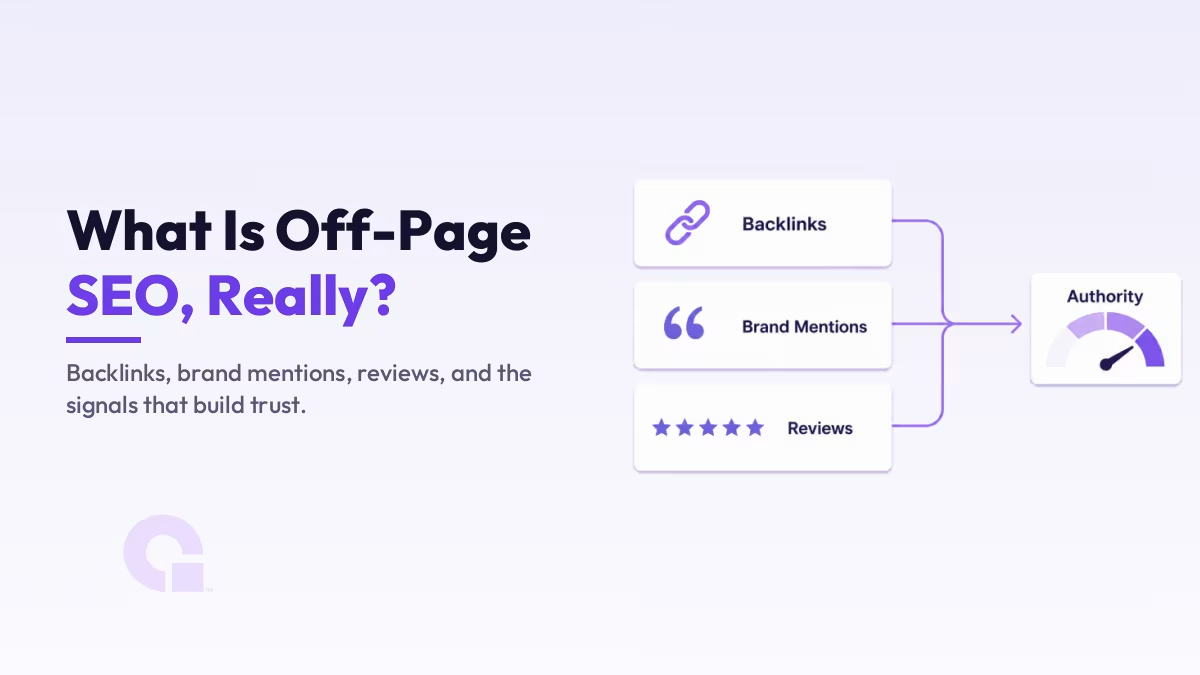
Off-page SEO is everything that happens away from your own website that still shapes how Google ranks it: the links pointing to you, the way people talk about your brand, your reviews, and where your name shows up across the web. If on-page SEO is what you say about yourself, off-page SEO is what everyone else says about you.
I will explain what off-page SEO actually is, which signals move rankings in 2026, and how to build them without chasing the junk links Google devalues anyway.
Key Takeaways
- Off-page SEO is the trust and authority you earn outside your own site, not just a pile of backlinks.
- Backlinks still carry the most weight, but the quality bar is far higher than it was ten years ago.
- Brand mentions, reviews, and digital PR feed the same trust signal, even when they do not link to you.
- Domain Authority (DA) is a third-party estimate Google does not use, so do not treat it as a target.
- On-page and off-page SEO are partners: a strong page earns links faster, and strong links make a good page rank.
What off-page SEO actually means
Off-page SEO covers every signal that builds your site’s reputation from outside your own pages. You will also see it called off-site SEO; the two terms mean the same thing. On-page SEO is what you control directly, like your content, titles, internal links, and structure, while off-page SEO is what the rest of the web says about you.
Google reads both to decide how far to trust a page. It can measure your on-page work by crawling you, but it cannot take your word that you are an authority, so it looks for outside evidence. Those outside votes, mostly links but not only links, are the heart of off-page SEO.
Why off-page SEO decides competitive queries
Two sites can publish near-identical content, and the one the web vouches for usually wins the competitive term. Because Google cannot personally verify every claim on the internet, it leans on third-party signals as evidence, and off-page SEO is where most of that evidence lives.
This is why a new site with genuinely good content often stalls. It has no external validation yet, so it sits behind older pages that everyone already links to. The uncomfortable part is that the links rarely arrive on their own: Ahrefs found that roughly two-thirds of pages have no backlinks at all, which is exactly why “publish it and they will come” fails so often.
The off-page signals that actually move rankings
Off-page SEO is broader than link building, though links are still the strongest single input. Each signal below tells Google a slightly different thing about your reputation, and they reinforce each other.
| Signal | What it is | What it tells Google |
|---|---|---|
| Backlinks | Editorially given links from other sites’ pages | Other people find you useful enough to point at |
| Brand mentions | Your name cited across the web, linked or unlinked | You are a recognized entity in your topic |
| Reviews and ratings | Star ratings and feedback on Google, industry sites | Real customers trust you, which matters for local and eCommerce |
| Digital PR and press | Coverage you earn in news, blogs, and podcasts | Credible outlets consider you worth featuring |
| Social and community | Shares, discussion, and profile presence | Not a direct ranking factor, but it drives discovery and branded search |
Backlinks deserve the most attention, but not the way most people play them. A link is a vote, and the relevance and context of the page giving it matter more than the raw domain score. One link from a smaller site that genuinely covers your topic, and sends you real referral traffic, often beats a link from a huge site on a page nobody reads. If you want the mechanics of how that authority passes between pages, I broke it down in what link juice is in SEO.
Brand mentions are the signal most people underrate. Google’s understanding of entities means an unlinked mention on a trusted site still ties your brand to a topic, which is close cousin to how meaning and context now drive rankings; I cover that in the semantic SEO guide. Off-page anchor text even shapes how your result reads, because Google sometimes uses it to write your title link in the SERP.
Reviews and reputation matter most for local businesses and stores, where ratings can show right in the SERP and tip a click your way. Social presence is not a direct ranking lever, but it feeds the pipeline: it gets your work seen, which is often what leads to the mention or the link in the first place.
How to build off-page authority without chasing junk links
The order here matters, because outreach with nothing behind it is the fastest way to waste a month. Build the asset first, then earn attention for it, then keep the reputation signals healthy.
- Make something genuinely link-worthy first: original data, a useful tool, or a strong, specific opinion, because a generic post gives no one a reason to cite you.
- Do real outreach and digital PR, since the links you want are placed by editors and writers who need to actually hear about you.
- Earn brand mentions by getting named in roundups, comparisons, and podcasts, so your name travels even where a link does not.
- Manage reviews: ask happy customers, and respond to every review, because that reputation layer is off-page SEO too.
- Reclaim what you already earned, turning unlinked mentions into links and fixing broken links pointing at you.
None of this needs to be spammy. The links that last are the ones a real person chose to give, which is precisely why Google’s link spam policies target the bought, swapped, and mass-generated kind. Keep your links crawlable and editorial, and you stay on the safe side of every update.
Off-page SEO myths worth dropping in 2026
A few beliefs still get repeated that quietly waste effort. The biggest is treating Domain Authority or Domain Rating as the goal. Those are third-party estimates from tool vendors; Google does not use a single domain-wide trust score, so chase relevance and real traffic instead of a number on a dashboard.
The second is “links are dying.” What died is easy, low-quality links; editorially placed, relevant links remain one of the strongest signals in every serious ranking study. The third is that great content earns links on its own. It is necessary but nowhere near sufficient, and believing it has quietly killed more campaigns than bad writing ever did. Balance cuts both ways though: the answer is not to swing back to buying links, it is to earn them deliberately.
So, how much should off-page SEO matter to your strategy?
If this were my site, I would treat off-page SEO as the half of the job that decides the competitive queries. Your on-page work makes a page eligible to rank; your off-page signals are what get it chosen over everyone else who is also eligible. That is why I would not pour months into content and then wonder why it sits on page three with no links pointing at it.
That said, keep it in proportion. On-page and off-page are partners, not rivals, and the fastest results come from a genuinely useful page that you then actively promote. Build the reputation honestly, ignore the vanity metrics, and off-page SEO becomes the moat that is hardest for competitors to copy.
Not sure where your off-page SEO stands?
If you want a straight read on your link profile and reputation signals, contact us or email me and I will point you to the fixes that matter. Off-page SEO is slow to build and hard to fake, which is exactly why getting it right pays off.
Update Logs
03 Jul 2026
- Rewrote the guide for 2026 with a clearer split between on-page and off-page, a plain-English rundown of the signals that actually count (links, brand mentions, reviews, digital PR), and honest myth-busting on Domain Authority and the “links are dying” claim.
Want our posts to show up more often on Google?
One step & Google will surface this site in your Top Stories.